

You are allowed to ask what a relationship means and whether the other person wants the kind of commitment you want. They are allowed to answer honestly, including with a different preference. The conversation gives you information for your own choices.
You do not need a perfect speech or a particular number of dates. Focus on what you want to understand, what you are asking for and what you will do with the answer.
On this page
- Name what commitment means to you
- Choose a time with enough space to talk
- Make a direct request without a test
- Clarify existing expectations without assuming the opposite
- Listen for the answer being offered
- Make a yes specific enough to use
- Give uncertainty a clear next step
- Respect a no and take your own needs seriously
- Pause a conversation that becomes intimidating
- Follow the agreement through in everyday life
Name what commitment means to you
“Getting serious” can mean different things. You might be asking about exclusivity, a relationship label, making regular plans, meeting important people or considering a shared future. Choose the question that matters now.
Write a sentence before the conversation: “I want to know whether we both want an exclusive relationship.” A specific request is easier to discuss than asking someone to prove that they care. You can value what you have while wanting a clearer agreement.

Choose a time with enough space to talk
Ask whether it is a good time rather than beginning during an argument, just before work or when either of you is unable to give the conversation attention. A simple invitation is enough: “Could we talk about where we each see this going?”
There is no universal waiting period. If expectations affect your choices now, asking about them is reasonable. You can discuss what you are each looking for early on without demanding an immediate promise about the future.
Make a direct request without a test
Use your own wishes and experience: “I enjoy seeing you, and I would like us to date exclusively. Is that something you want too?” Then give them time to respond.
Avoid jealousy tests, hints designed to provoke a reaction or presenting someone else’s relationship as the standard they must meet. You are asking for a shared decision. For a related discussion, read about finding a dating pace that works for both people.
Clarify existing expectations without assuming the opposite
If you have understood the relationship differently, name that difference. Neither silence nor a particular pattern of dates tells you everything about the other person’s understanding.
Ask what agreements each of you believes are already in place. Do not use a missing label as a reason to disregard a promise you have made. If expectations have changed, discuss the change openly before acting on it. Where uncertainty affects intimacy, have a separate conversation about consent and sexual-health choices.
Listen for the answer being offered
“Yes,” “I do not want that” and “I am unsure” give you different information. Ask a clarifying question if needed, while leaving room for an answer you did not hope for.
A quiet or careful answer is not automatically less sincere than an enthusiastic one. Look for a freely given agreement that each person can explain and follow. Equally, affection does not turn an explicit refusal into a hidden promise that will appear if you try harder.
Make a yes specific enough to use
If you both want commitment, discuss what you are agreeing to. Depending on the relationship, that could include dating other people, dating-app use, communication expectations or how you will raise a change of mind.
Do not treat commitment as automatic permission to check a phone, demand passwords or announce the relationship publicly. Personal and digital boundaries still need discussion. Choose a few relevant agreements now, with room to revisit them, instead of trying to write rules for every possible future situation.
Give uncertainty a clear next step
If someone wants time to think, ask what they need to consider and whether they want to return to the conversation. A mutually chosen check-in can help you avoid waiting for an undefined signal.
You can decide how long an uncertain arrangement works for you. A boundary describes your choice: “I am looking for exclusivity, so I do not want to continue dating without it.” It should not become a threat intended to force a yes. You can also pause dating while you consider what you want.
Respect a no and take your own needs seriously
You do not have to argue someone into wanting the same relationship. Ask only for the clarification you need, then consider whether the arrangement they offer is one you freely want.
Continuing casually, taking space or ending the relationship are possible choices; none is compulsory. Be clear about any changed agreement. This article on waiting for commitment can help you consider the difference between a real offer and a hope you are carrying alone.
Pause a conversation that becomes intimidating
Disappointment or a different preference does not justify insults, threats, pressure or punishment for asking a question. You can stop the conversation and choose when, where or whether to continue it.
If you fear the other person’s reaction, you do not owe them a private in-person discussion. Consider trusted support and a setting or method that allows you to make choices safely. The purpose of this conversation is clarity, not proving your courage by enduring an unsafe response.
Follow the agreement through in everyday life
Afterward, notice whether both people’s actions fit the agreement. If something is unclear, return to the specific point rather than repeating the whole conversation as a test of love.
Commitment does not remove the need for communication or guarantee a lasting outcome. It can provide a clearer basis for deciding how you spend time, what you share and what you expect from each other. Keep room for either person to raise concerns and for you to decide whether the relationship continues to fit your needs.
Read the infographic in text
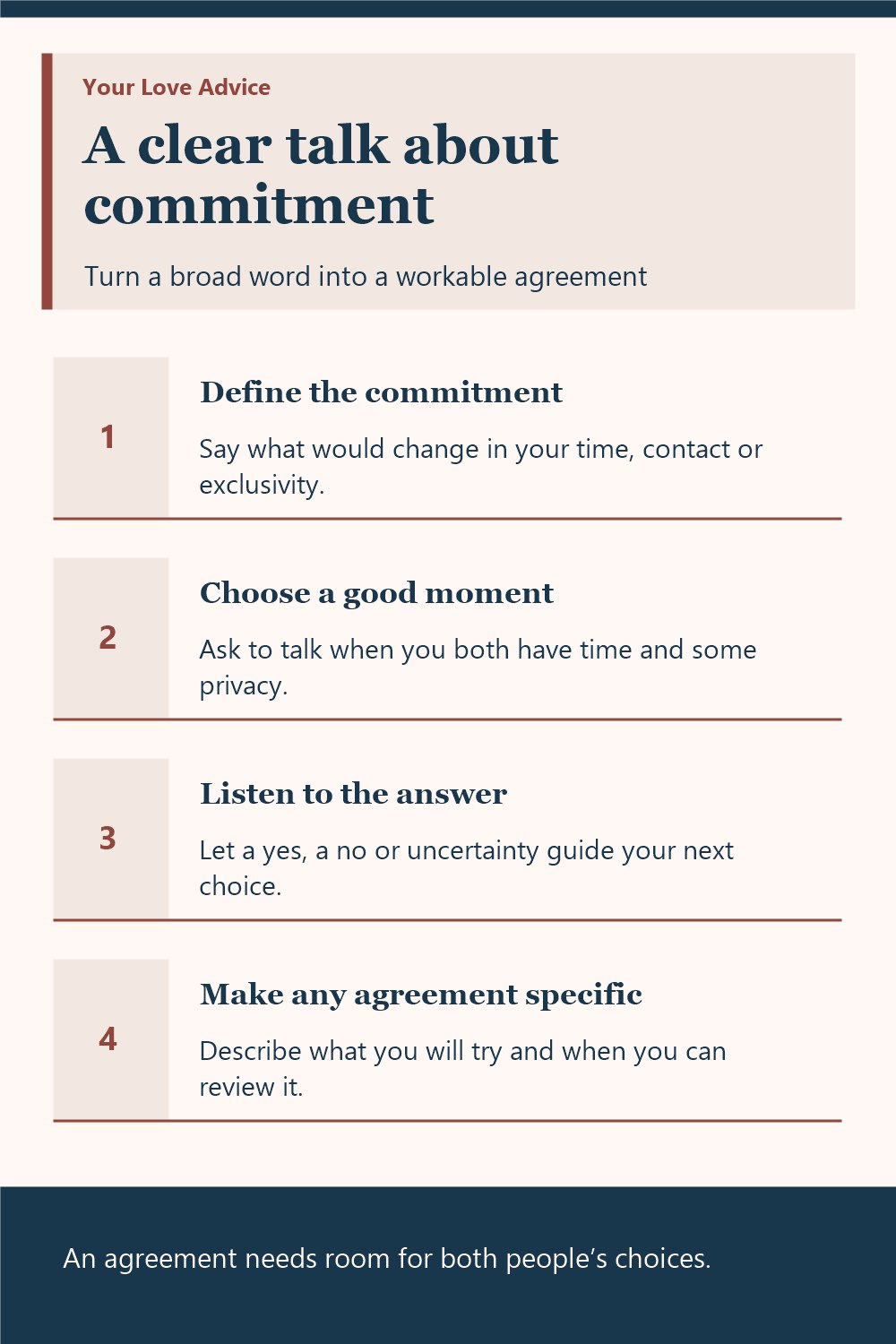
A clear talk about commitment Turn a broad word into a workable agreement
- Define the commitment Say what would change in your time, contact or exclusivity.
- Choose a good moment Ask to talk when you both have time and some privacy.
- Listen to the answer Let a yes, a no or uncertainty guide your next choice.
- Make any agreement specific Describe what you will try and when you can review it.
An agreement needs room for both people’s choices.