

Wanting a relationship with someone does not mean you can make him want the same arrangement. You can show interest, ask about commitment and explain what you are looking for. His answer still belongs to him, and your decision about what works for you belongs to you. Clearer conversations can help you make that decision without turning dating into a test of how indispensable or desirable you can become.
In this article
Decide what a relationship means to you
Before asking for commitment, think about the arrangement you actually want. You may be looking for exclusivity, regular time together, a shared future or simply clarity about whether you are dating. These are related questions, but they do not always have the same answer.
Choose a few practical priorities. Would you want to make plans ahead of time? Discuss whether you are seeing other people? Be able to introduce one another as partners? You do not need to produce a complete life plan, but specific wishes give you something clearer to discuss than whether things are “serious.”
Consider what you like about this particular connection as it is now. Enjoying his company and wanting a different arrangement can both be true. Try to separate the relationship you currently experience from the one you hope might appear if you work hard enough.
Ask what he wants without testing him
Find a time when you can speak without rushing and when it feels safe to be direct. You might say, “I enjoy spending time with you, and I’m looking for an exclusive relationship. Is that something you want too?” A clear question gives both people a chance to explain.
Listen for what he actually says rather than the answer you could persuade him to give. “I only want casual dating” is useful information, even when it is disappointing. Casual dating can suit people who both want it; you do not have to agree to it while privately waiting for a different relationship.
If he is uncertain, ask what that means in practice. Does he want more time to get to know you, or is he saying he does not want commitment? You can agree to revisit the conversation at a time that suits both people. An agreement to talk again is not a promise that his answer will change.
There is no need to make him list what he loves about you, provoke jealousy with an ex or disappear to create a chase. Those tactics can add confusion without telling you whether he freely wants the relationship you want.
Compare the answer with ongoing behaviour
Words matter, and so does follow-through. Notice whether plans are reasonably mutual, changes are communicated and agreed limits are respected. A relationship label does not replace attention to how you are treated.
Give ordinary misunderstandings room for clarification when you want to and feel safe. “We said we would make a plan this week, but that hasn’t happened. Do you still want to?” is more specific than guessing what every delayed message means. Look at repeated patterns rather than requiring perfect communication.
Meeting his family, being invited on a trip or helping with a problem can be meaningful experiences. They do not establish exclusivity or a shared future by themselves. Discuss the agreement directly instead of using an event as a substitute for a conversation.
Equally, a person can be kind and still want something different. You do not have to prove that he is a bad person before deciding that the arrangement leaves you unhappy or does not fit your plans.
Keep room for both people’s choices
You can offer affection and support without trying to become his only source of comfort or solve needs he has not asked you to meet. A connection works better as a choice both people make than as an obligation created through constant favours.
Keep your own friends, interests and responsibilities in view. Discuss time together and time apart rather than joining activities or entering social spaces mainly to make your lives harder to separate. Getting to know family and friends should not become a campaign to recruit their pressure.
Physical affection should be wanted by both people, rather than used as a reward for boyfriend-like behaviour. Love is respect’s guidance on respecting a partner’s boundaries explains why different wishes and privacy deserve respect. Neither person owes constant availability, passwords or intimacy as proof of commitment.
Take pressure, threats, intimidation and attempts to isolate you seriously. If you are afraid of his response to a limit or a decision to leave, consider confidential help from a relationship-abuse support service when planning your next step.
Choose what you can accept
After the conversation, ask whether the current arrangement is something you freely want. If it is not, you can step back without creating a test or threatening a consequence to obtain the answer you prefer. A boundary describes what you will do, such as declining further casual dates when you want a committed relationship.
If you both want to continue, make the agreement understandable. Talk about what exclusivity, contact and plans mean to each of you, and leave room to revisit practical details. Neither person needs to surrender every independent choice to be a partner.
If your wishes differ, disappointment does not mean that you were insufficiently attractive, supportive or patient. You can care about someone and still decline an arrangement that does not suit you. The aim is an honest choice about the relationship available to both people, rather than finding the right technique to make him yours.
Read the infographic in text
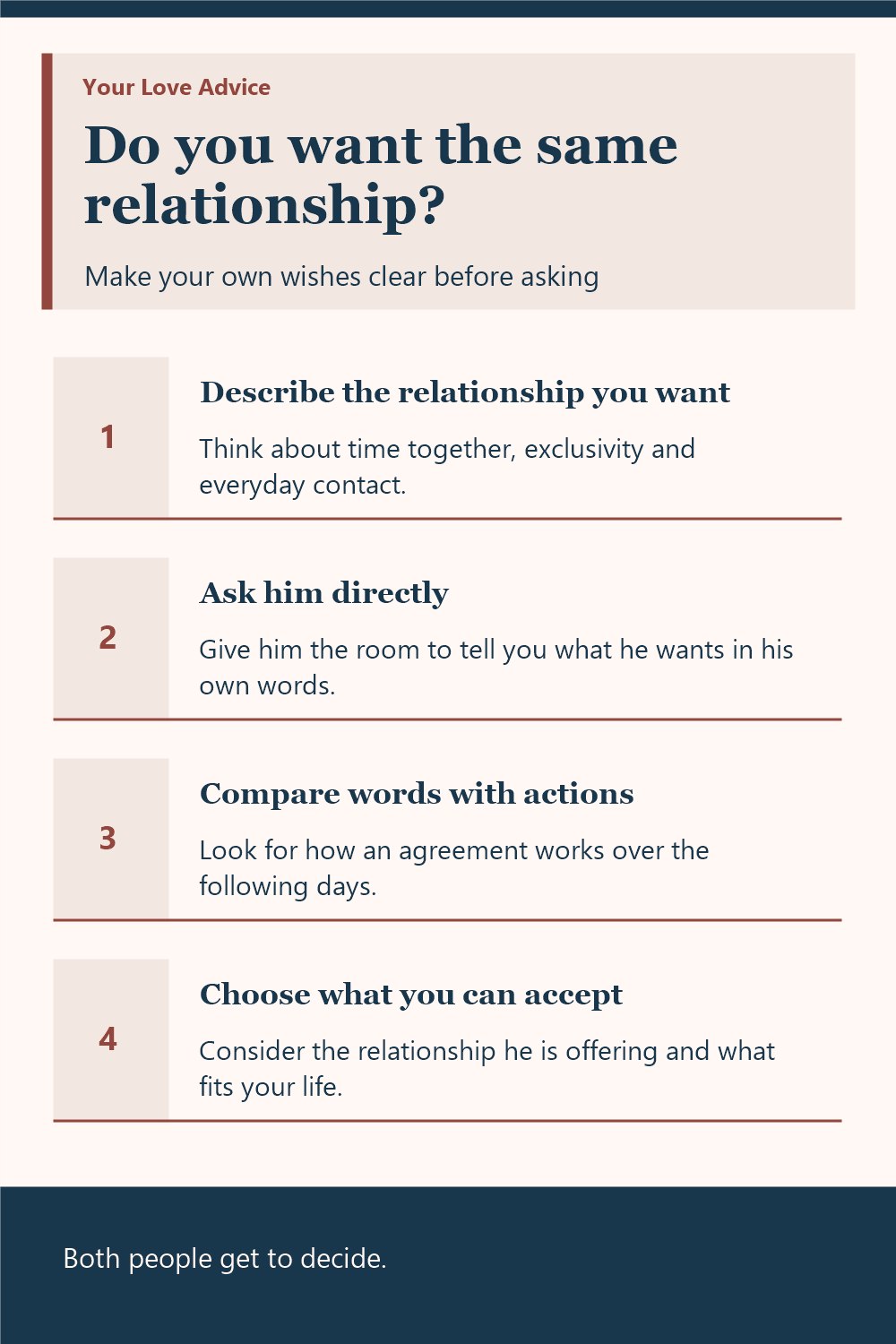
Do you want the same relationship?
Make your own wishes clear before asking
- Describe the relationship you want Think about time together, exclusivity and everyday contact.
- Ask him directly Give him the room to tell you what he wants in his own words.
- Compare words with actions Look for how an agreement works over the following days.
- Choose what you can accept Consider the relationship he is offering and what fits your life.
Both people get to decide.