

Waiting for someone to decide about a relationship can leave important parts of your life uncertain. You may care about them while wanting clearer plans, exclusivity or a different level of commitment. Begin by naming the decision you are actually waiting for.
There is no universal number of dates or months that answers whether you should stay. You can consider what is offered now, what you need and the effect of waiting on your life. Neither person has to agree to a relationship they do not want.
On this page
1. Define the commitment you want
Try replacing a broad wish to be “serious” with the arrangement that matters. Are you asking to date exclusively, make regular plans, acknowledge the relationship publicly or discuss living together? Those choices can involve different responsibilities and different answers.
Describe your own wishes without assuming the other person shares them: “I would like an exclusive relationship. Is that something you want with me?” A direct question gives both of you more room to respond than testing whether a particular gesture proves love.
You can want stability without expecting marriage or a shared home. You can also decide that a casual arrangement does not suit you, even when it has good parts.
2. Ask what the person is offering now
Listen for the present answer as well as a possible future. “I enjoy seeing you, but I do not want exclusivity” describes an arrangement you can consider. “Maybe one day” leaves more uncertain. You can ask what they mean without turning the conversation into an effort to obtain the answer you hoped for.
Affection and commitment are different questions. Someone may care about you and still be unable or unwilling to choose the partnership you want. Their private reason may remain unclear; you can decide based on the relationship actually available.
If the answer is no, respect it. Do not treat further gifts, constant availability or a threat to date someone else as ways to turn that answer into agreement. Give your own feelings support outside the negotiation.
3. Discuss the obstacle in practical terms
If both people want the relationship but identify a difficulty, ask what change would help. Work schedules, distance, health or caring responsibilities may require different arrangements. A specific discussion can show whether the proposed step is realistic for both people.
For example, “We cannot meet every weekend” might lead to a conversation about visits that are possible. “I do not want a relationship” is a different answer. More time does not automatically resolve a difference in what you want.
You do not need to diagnose the person as emotionally unavailable or decide that they must be fully free of difficult feelings. Ask what they can offer and whether it fits enough of your needs. Their challenges deserve respect, and your limits deserve a place in the discussion.
Love is respect’s questions about readiness to date consider wishes, time, boundaries and the effort someone can offer. They can support reflection without becoming a test that makes either person ready.
4. Choose whether a review point would help
If you freely choose to continue for now, consider what you would be agreeing to during that time. Be clear about contact, dating other people and any expectations that affect your choices. Avoid assuming exclusivity while the other person assumes something different.
You might agree to revisit the conversation after a practical event or at a time you choose together. Name what you hope will be clearer then. A review point can help you assess an arrangement; it cannot promise that feelings or intentions will change.
A personal limit is something you can act on: “I do not want to continue dating without an agreement about exclusivity.” Say it honestly when it is safe, and leave the other person free to decline. You can also decide that you do not want another waiting period.
5. Keep room for the rest of your life
Look at what the uncertainty is affecting. You may be setting aside evenings for unconfirmed plans, delaying a decision or spending much of your attention checking for messages. Choose one adjustment that gives your time a clearer shape.
For example, you could make your own plans if a visit has not been confirmed or keep a regular activity with a friend. Choose these things for your own life, rather than as a strategy to make the person worry about losing you.
Ask what waiting would cost and what continuing offers you now. Those are personal considerations, not a judgment that you caused disappointment by being patient. Past time and care do not create a duty to keep waiting.
6. Make the decision that is available to you
You might continue under a clearer agreement, slow the pace, stop dating or take time to think. Consider the words you have heard, the actions you have experienced and the wishes that remain different. You do not need certainty about someone’s future to make a choice about your present.
If you decide to leave, explain the decision as clearly as your safety allows. You do not need to prove that the person is bad or that the connection meant nothing. Disappointment can exist alongside a decision that an arrangement does not fit.
If you fear threats, pressure or retaliation, seek individual specialist support about safer options. A routine commitment conversation may not be appropriate in that situation.
You can care for someone without keeping every part of your life open for a possibility they have not chosen. Give yourself room to act on what you need, and respect the same freedom in the other person.
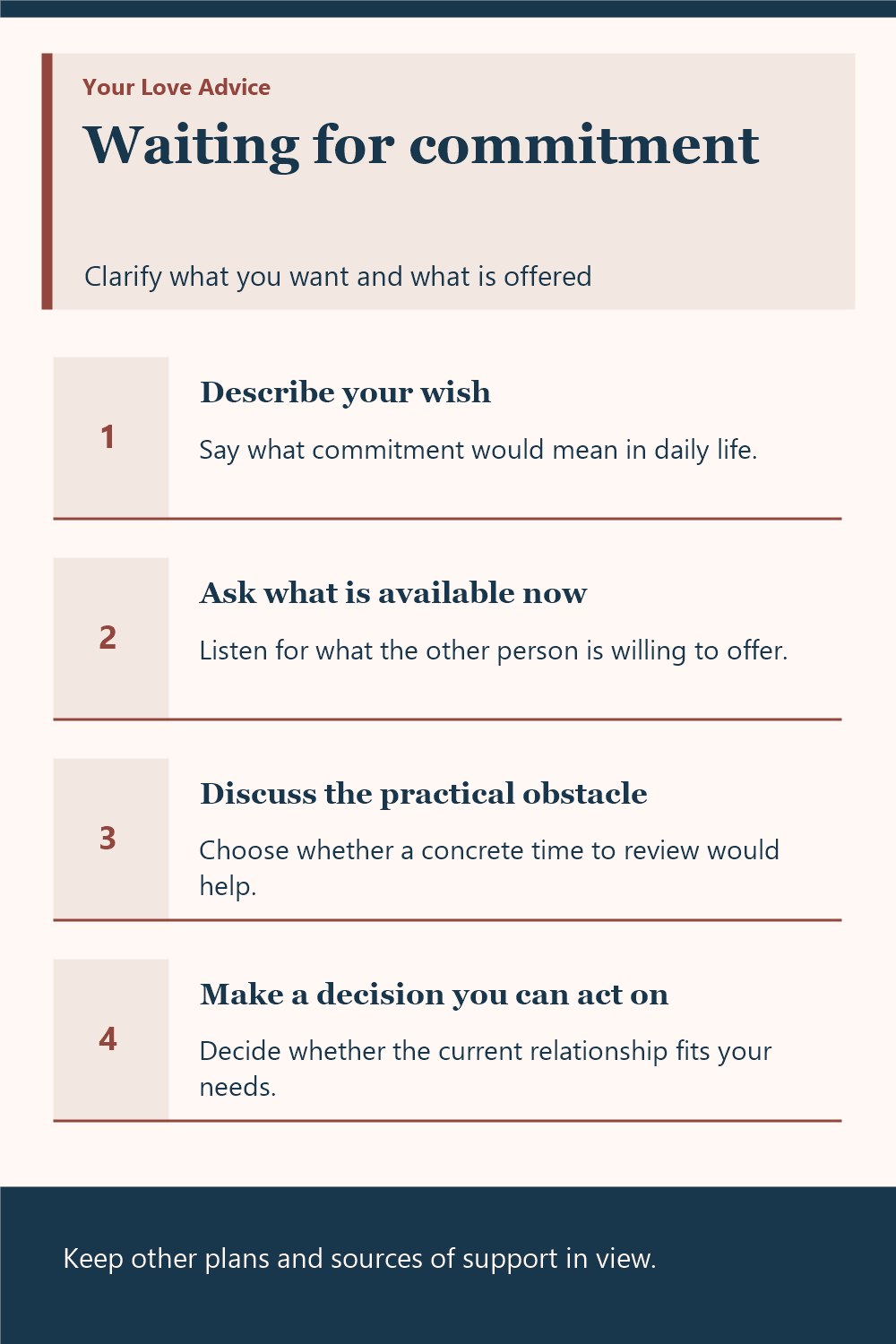
Read the infographic in text
Waiting for commitment Clarify what you want and what is offered
- Describe your wish Say what commitment would mean in daily life.
- Ask what is available now Listen for what the other person is willing to offer.
- Discuss the practical obstacle Choose whether a concrete time to review would help.
- Make a decision you can act on Decide whether the current relationship fits your needs.
Keep other plans and sources of support in view.