

A cancelled plan or a short reply can leave you hurt, worried or unsure what to do. Sometimes you have important information about a pattern. Sometimes the meaning is still unclear. You can take the feeling seriously while checking what you actually know.
This is not a test of whether you are a positive person. The aim is to respond to the situation more clearly, without labelling yourself or dismissing genuine mistreatment.
On this page
- Describe the event before describing the person’s character
- Give the feeling and the interpretation different names
- Notice broad conclusions without diagnosing yourself
- Check one assumption with a clear question
- Keep real mistreatment in view
- Choose a practical response that fits your needs
- Keep the exercise manageable
Describe the event before describing the person’s character
Start with a specific observation: “We agreed to speak this evening, and I have not heard from you.” That is different from “You never care about anyone.” The first gives you an event to ask about; the second makes a much broader claim.
Include relevant context. If the same agreement has been broken repeatedly, that pattern matters too. Being specific should help you describe a concern, rather than require you to pretend each incident happened in isolation.
Give the feeling and the interpretation different names
You might feel disappointed and think, “They must be losing interest.” The disappointment is part of your experience. The conclusion about their interest may still need a conversation.
Try writing both down: “I feel hurt because I was looking forward to talking. I am interpreting the silence as rejection.” This does not make the feeling irrational or the interpretation automatically wrong. It helps you identify which part is yours to express and which part remains uncertain.
Notice broad conclusions without diagnosing yourself
Watch for words such as “always,” “never” or “everything” when one event becomes a verdict on the whole relationship or your worth. Also notice when you assume you know someone’s thoughts, predict an outcome or blame yourself for something outside your control.
The NHS guide to reframing unhelpful thoughts suggests looking at the evidence and considering other explanations. A more balanced view does not have to be cheerful. “I do not yet know why the plan changed” may be more accurate than either “They hate me” or “Everything is fine.”
Check one assumption with a clear question
Choose a concern you can discuss safely. You could ask, “When the plan changed, I felt left out. What happened, and can we agree how to let each other know next time?” Listen to the answer alongside the behaviour that follows.
A short written check can help you prepare:
- What happened that I can describe specifically?
- What meaning am I giving it?
- What information would help me decide?
- What request or limit do I want to communicate?
If your uncertainty concerns dating intentions, this guide to intentions, availability and follow-through offers questions to ask directly.
Keep real mistreatment in view
Checking an interpretation should not become an instruction to explain away insults, threats, deception or control. A possible reason for someone’s behaviour does not remove its effect or make you responsible for accepting it.
You do not have to find a more positive thought before setting a boundary. If you feel unsafe raising a concern, seek private support suited to that situation rather than treating a confrontation as a required exercise. When an important agreement has actually been broken, consider accountability and your choices about trust rather than asking yourself to ignore what happened.
Choose a practical response that fits your needs
Your next step might be a question, a clearer agreement, some time to think or a decision not to continue the arrangement. You can be uncertain about another person’s motive and still know that the current contact is not working for you.
If self-criticism is part of the difficulty, read about responding to setbacks without turning them into a verdict on your worth. If you are supporting a partner, this guide to care and boundaries around low self-esteem keeps both people’s needs in view.
Keep the exercise manageable
You do not need to analyse every message or produce a perfect explanation for every feeling. Try one situation where a little more clarity would help. If writing things down increases rumination, pause and consider another kind of support.
A trusted person may help you separate an event from a harsh conclusion without deciding the whole relationship for you. If distress persists or interferes with everyday life, consider suitable professional support. Checking a thought is one possible practice; it cannot make another person honest, respectful or willing to participate.
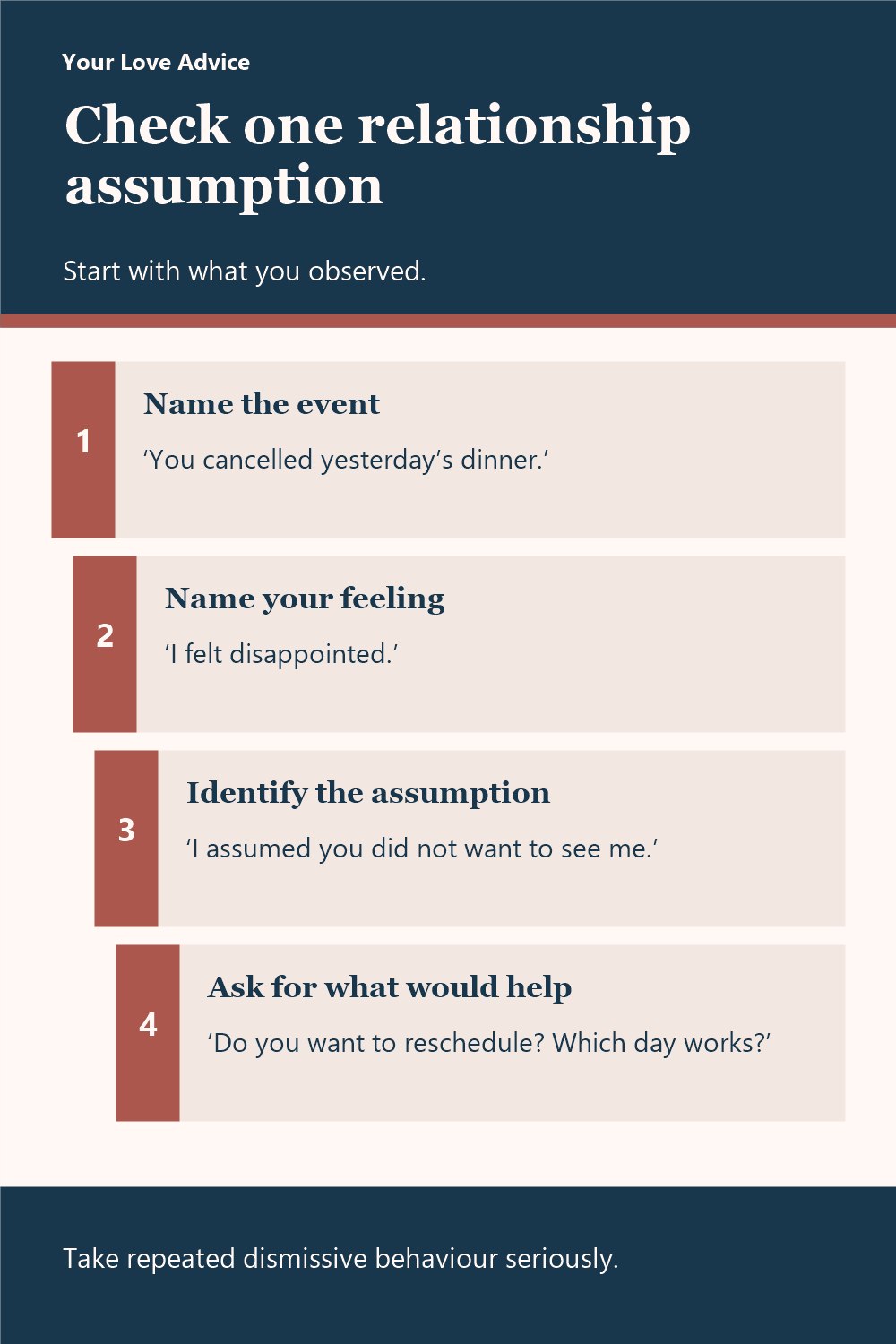
Read the infographic in text
Check one relationship assumption Start with what you observed.
- Name the event ‘You cancelled yesterday’s dinner.’
- Name your feeling ‘I felt disappointed.’
- Identify the assumption ‘I assumed you did not want to see me.’
- Ask for what would help ‘Do you want to reschedule? Which day works?’
Take repeated dismissive behaviour seriously.