

When a new connection feels exciting, you may imagine a future together before you know much about the person. You can enjoy that hope while leaving room to discover what each of you actually wants. Strong feelings do not require an immediate decision about every next step.
Choose a pace through clear conversations, realistic plans and attention to both people’s comfort. You do not have to hide a wish for commitment, accept casual dating you do not want or hurry someone else to match your feelings.
On this page
1. Separate a hopeful picture from an actual agreement
You might enjoy imagining holidays together or a shared home. Those thoughts describe a possibility you find appealing; they do not establish what the other person has chosen. Ask yourself what you know from conversation and what you are still imagining.
There is room to feel excited without building your plans around an unconfirmed future. Focus on the next invitation or conversation you both want. You can learn something useful from ordinary time together.
If the imagined future is making a practical choice feel urgent, pause to name the choice itself. A date, exclusivity and living together are different decisions. You do not have to settle them all because one evening felt meaningful.
2. Say what you want without trying to produce a particular answer
If you hope for a relationship, you can say so. Discussing intentions does not automatically make you too attached or mean that you have frightened someone away. It gives each person information they can use to decide whether to continue.
Try an opening such as, “I am interested in getting to know you with a relationship in mind. What are you looking for?” Listen to the present answer. A difference in wishes may be disappointing without making either person wrong.
Do not assume that agreeing to casual dating will eventually create the commitment you want. You can decide whether the arrangement available now is something you would freely choose.
3. Choose the next step through mutual comfort
Talk about contact, dates, exclusivity and physical affection as separate subjects. Ask what feels comfortable and explain what you would prefer. A yes to one plan is not an automatic yes to the next one.
One Love’s healthy relationship guide includes a comfortable pace and independence. The useful question is whether the pace works for both people, with room to speak and decline without pressure.
If you want different things, consider whether there is an arrangement you both genuinely want. You can also decide that there is no workable middle ground. A boundary around unwanted contact or intimacy should not be negotiated away to keep the connection.
4. Keep room for friends, interests and rest
Notice whether new plans are crowding out something important to you. A friendship, activity, responsibility or quiet evening may still need a place in the week. Keep those parts of life because they matter to you, rather than as a tactic to seem less interested.
Make plans you can maintain. You might choose a particular evening together instead of leaving every evening open for a possible message. Clear arrangements can make time easier to organise for both people.
Give the other person the same room for an independent life. A delayed reply or an existing commitment is not automatically a rejection. If a pattern is affecting you, discuss that pattern and what kind of contact you need.
5. Get to know the whole person over time
Ask about interests, everyday routines and wishes, and notice how each person treats the other. You do not need to search for flaws to cancel out excitement. Stay curious about what you are learning and what still matters to discuss.
If something sounds inconsistent, ask for clarification instead of assuming that everyone exaggerates when dating. You can take an unclear answer or a broken agreement seriously without needing to prove that every part of the person is false.
You may have a strong feeling about the connection. Let it sit alongside current words and actions. Neither a promising feeling nor a checklist can decide every question of compatibility for you.
6. Discuss introductions and practical choices
Meeting friends or family can happen at different times for different people. Explain what an invitation involves and ask whether it is welcome. An introduction does not by itself make a relationship permanent or tell you how much someone cares.
Give decisions about housing, shared money or involvement with children their own careful discussion. Familiarity or excitement can make a step feel appealing while leaving practical questions unanswered. You can take time to understand those responsibilities.
If a plan feels too large, suggest an option you would prefer. A shorter visit or a different occasion may fit better. Both people should remain free to say that a particular step is not right for them.
7. Review whether the pace still fits
After a few experiences together, consider what has felt comfortable and what has not. Can you ask for a change? Are plans and wishes clearer? Is there enough room for both people’s choices?
You might keep the same pace, slow down, ask for a clearer agreement or stop dating. Try to make the choice about your needs and the connection available, rather than about appearing perfectly relaxed or winning someone’s attention.
If uncertainty is taking over sleep, work or ordinary life, consider wider support for yourself. If attempts to set a limit bring threats or fear, seek individual specialist advice about safety. You deserve room to decide without being pressured.
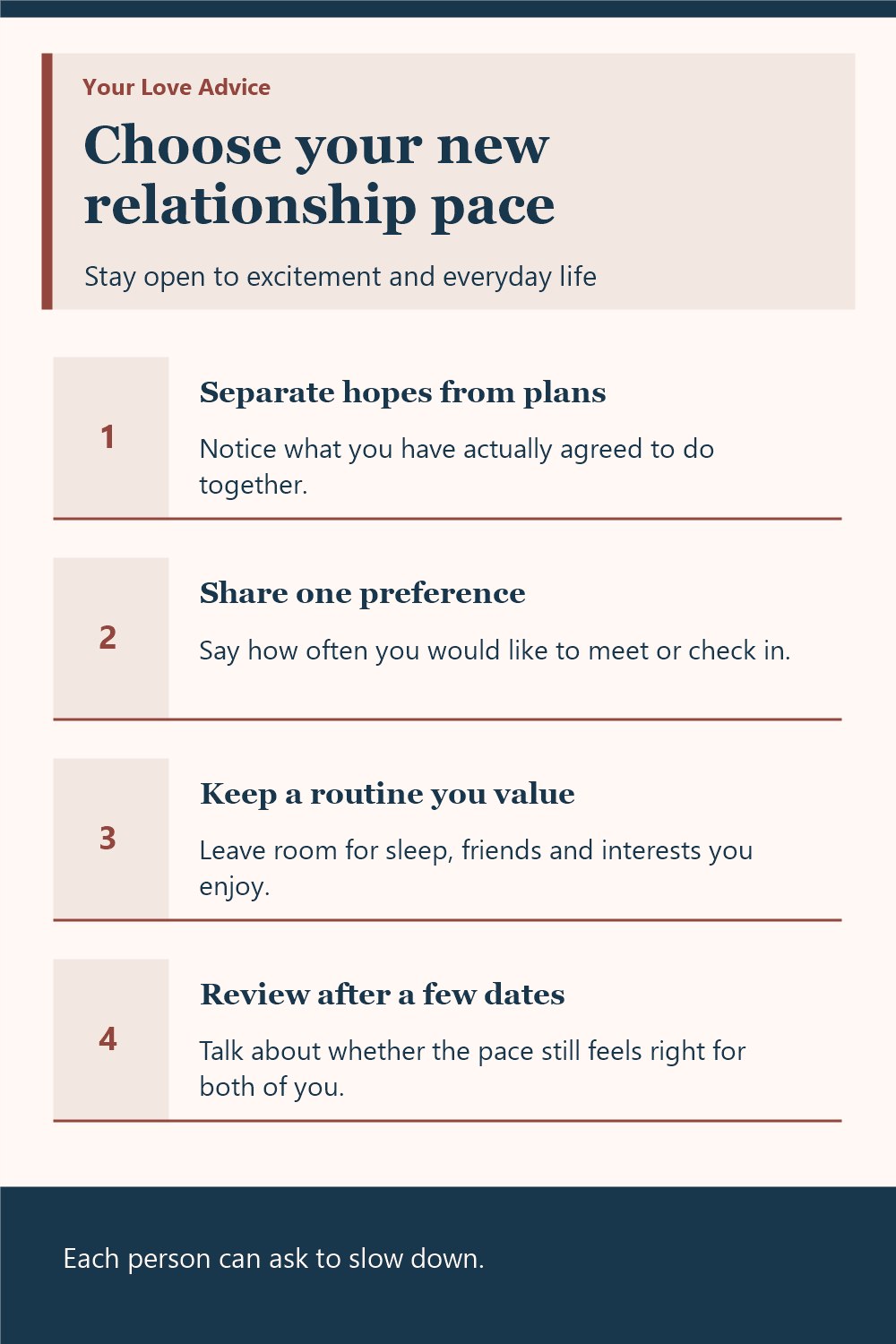
Read the infographic in text
Choose your new relationship pace Stay open to excitement and everyday life
- Separate hopes from plans Notice what you have actually agreed to do together.
- Share one preference Say how often you would like to meet or check in.
- Keep a routine you value Leave room for sleep, friends and interests you enjoy.
- Review after a few dates Talk about whether the pace still feels right for both of you.
Each person can ask to slow down.