

When you want a relationship and it has not happened, other people’s weddings, announcements or advice can leave you feeling behind. That disappointment deserves care. It is not a verdict on your worth or proof that you have failed at love.
Hope does not require a promise that a partner will arrive. You can stay open to connection while making choices that support your life now, including choosing a break from dating. Start with whichever of these eight ideas feels useful.
On this page
- Let a birthday be information, not a verdict
- Leave room for meaning without making one person your only chance
- Notice what you understand more clearly
- Distinguish important needs from flexible preferences
- Give present-day life some attention
- Make invitations that leave both people free
- Let support include more than romance
- Choose a next step without predicting the whole future
Let a birthday be information, not a verdict
Your priorities, circumstances and hopes can change at different ages. Ask what a relationship would need to fit your life now rather than treating a birthday as an expiry date for being worthy of affection.
You may want different things from dating than you did before. That could mean clearer communication, a slower pace, an accessible meeting place or more time for family and friends. Naming those needs gives you a useful question to explore with someone; it does not make you late.
Leave room for meaning without making one person your only chance
Some people find the idea of a soulmate meaningful. You do not have to abandon that belief to consider whether an actual relationship offers respect, compatibility and room to choose.
A powerful connection need not become a rule that you must wait forever, accept unwanted behaviour or pursue someone who has declined. Whatever language you use for love, keep the person’s actual words and actions in view. The importance of a feeling does not decide the other person’s wishes for them.
Notice what you understand more clearly
Experience can help you name what feels welcome and what does not. You might recognise that you need dependable plans, freedom to keep friendships or a partner who shares responsibility. Write down one thing you want to carry forward.
You do not have to turn every disappointment into a lesson or prove that pain made you stronger. Reflection is useful when it gives you more choice, rather than another reason to blame yourself. You can also ask a trusted person for help noticing a pattern you find hard to sort through alone.
Distinguish important needs from flexible preferences
Feeling lonely does not mean you have to accept disrespect or an arrangement you do not want. Identify a few needs you do not want to negotiate away, such as consent, honesty or the freedom to make your own choices.
Then consider which preferences are more flexible. A different hobby or communication habit may invite a conversation rather than a quick rejection. You decide what matters to you; the goal is clarity about your reasons. Our guide to wanting a relationship while choosing your own pace explores this further.
Give present-day life some attention
Choose something worth caring about even if it does not lead to a date. It could be a friendship, a small project, rest or a routine that makes your week easier. A relationship does not have to be the condition for allowing yourself those things.
Your time may already involve work, caring responsibilities, limited money or access needs. You do not need an elaborate new lifestyle. Ask what is manageable within your circumstances, and where support would help. Enjoying something now does not mean giving up on the relationship you would like.
Make invitations that leave both people free
If you want to meet people, choose a setting or activity you can comfortably take part in. A shared-interest group, a friend’s invitation or a simple conversation can be worthwhile without becoming a test of whether you will find a partner there.
You can make one clear invitation and accept the response. Interest grows through mutual participation, rather than enough persistence to overcome a refusal. Equally, you can decline someone who is kind but does not feel right for you. Hope does not oblige either person to say yes.
Let support include more than romance
A wish for a partner is valid, and other forms of connection can still matter. Think about who you would like to hear from, spend time with or ask for a little support. You do not have to pretend those relationships replace every part of romantic closeness.
If loneliness is weighing on you, the NHS offers practical guidance and support options, including keeping in touch and finding shared activities. Start with a step that feels possible. If the difficulty is persistent or affecting daily life, consider appropriate professional support as well.
Choose a next step without predicting the whole future
You might send one message, update what you want from dating, accept an invitation or take a break. Choose an action that respects your energy and leaves room for other people to choose too.
If a previous relationship is shaping what feels possible, this article on dating after heartbreak offers questions about readiness and pace. You do not need to know whether or when you will find a partner before caring for yourself now.
Keep hope in a form that supports your life, rather than requiring you to postpone it.
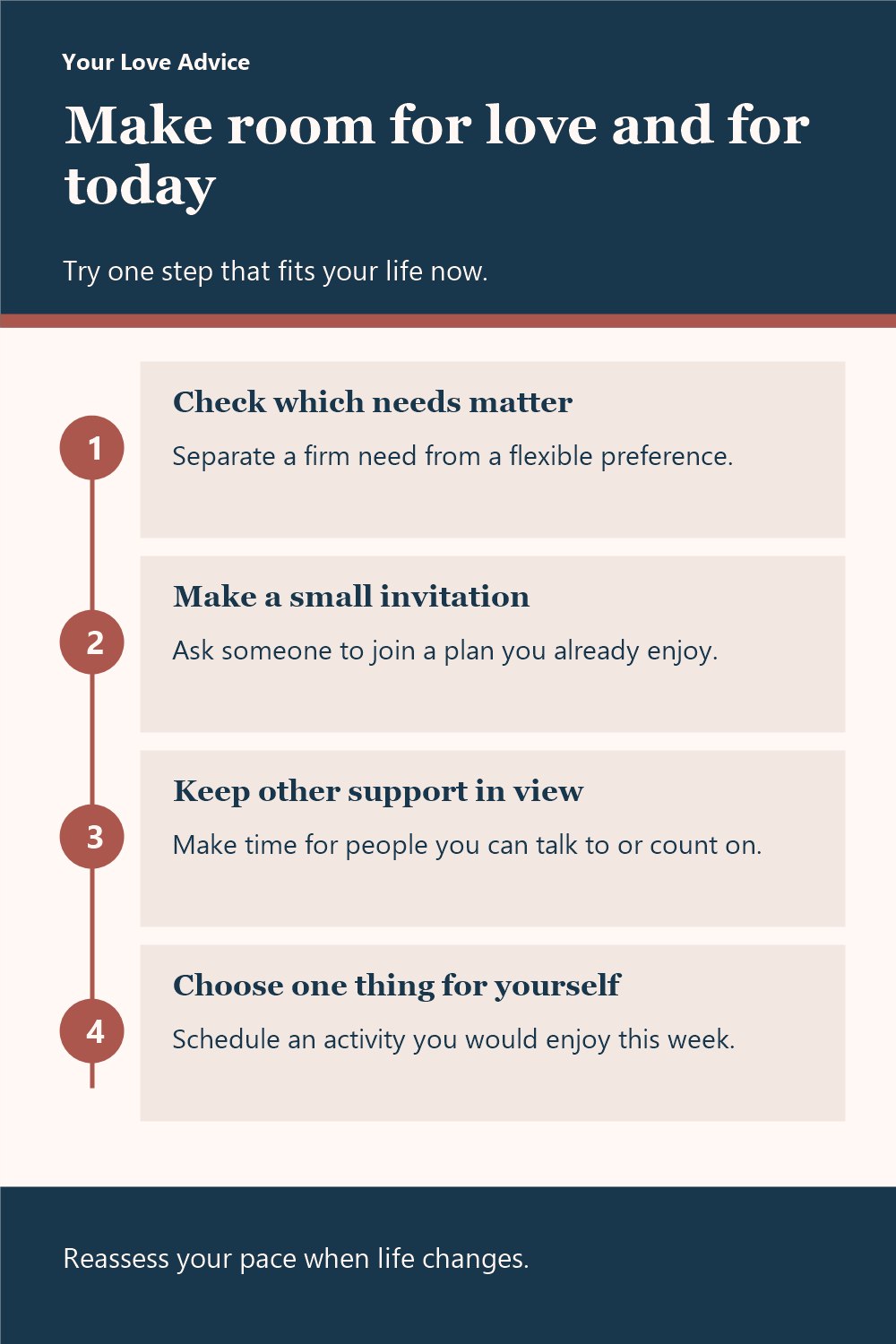
Read the infographic in text
Make room for love and for today Try one step that fits your life now.
- Check which needs matter Separate a firm need from a flexible preference.
- Make a small invitation Ask someone to join a plan you already enjoy.
- Keep other support in view Make time for people you can talk to or count on.
- Choose one thing for yourself Schedule an activity you would enjoy this week.
Reassess your pace when life changes.