

You and a partner can remember the same disagreement differently. One person recalls a dismissive remark; the other remembers trying to explain a change of plan. A difference in recollection is a reason to ask questions, not proof that every account is equally accurate or that someone must be lying.
The aim of a useful conversation is to understand the concern and decide what to do about it. You do not have to win a complete verdict on the other person’s character before asking for a change.
On this page
Move from proving a point to describing the problem
Choose one event you can describe specifically. “We agreed to leave at seven, and I waited for half an hour without an update” gives you something to discuss. “You always ruin everything” expands the argument beyond the event.
Ask what each person understood the agreement to be. You may discover a practical difference, such as one person treating a time as approximate and the other arranging transport around it. You may also find that an agreement was clear and was not kept.
Understanding an explanation does not require accepting every part of it. Stay with the issue that needs a decision rather than gathering unrelated faults to strengthen your case.
Name the feeling without treating it as the whole explanation
You may feel hurt, dismissed or worried. Say what the experience was like for you while leaving room to check the meaning you are giving it: “I felt unimportant when I did not hear from you” differs from “You wanted me to feel unimportant.”
Listen to what the other person says, and ask for clarification where it matters. You can acknowledge their frustration without agreeing that an insult was acceptable or that your own concern should disappear.
If an uncertain interpretation is driving the conversation, this guide to checking relationship assumptions offers a way to separate an observation, a feeling and a question.
Give unresolved concerns their own place
An old issue may return because it has not been addressed, rather than because someone is choosing to be negative. Ask what remains unresolved and what decision or action is still needed.
If several concerns are being raised at once, agree which one to discuss now and how to return to the others. Writing a short list can help if both people find it useful; it should not become a permanent scorecard of each other’s mistakes.
A pleasant memory can remind you why the relationship matters. It does not cancel a broken agreement or require someone to stop talking about harm. Consider the present concern on its own terms.
Make repair specific and proportionate
Repair may include an apology, correcting inaccurate information, replacing something damaged or making a clearer agreement. Describe the action rather than offering only “We will do better.”
Each person can take responsibility for their own behaviour. That does not mean responsibility must be divided equally. One person’s disappointment does not cause another person’s choice to threaten or deceive.
For a recurring practical disagreement, you could ask:
- What happened that needs addressing?
- What does each person need understood?
- What change can we freely agree to make?
- How will we check whether the change is helping?
Our guide to agreements and follow-through considers how a promise becomes something usable.
Use a pause that leaves a clear next step
If the conversation is becoming too heated to continue usefully, say that you need a pause. Where it is safe and realistic, agree when or how you will return to the issue. A pause should help you regain space to think, rather than punish someone through an unexplained disappearance.
You can also decide that a particular setting is unsuitable. A rushed conversation before work may need a different time; an argument in front of children may need to stop. Neither person has to solve everything in one sitting.
A request to continue later does not oblige you to remain in a threatening situation. Prioritise the support and space needed for your safety.
Consider the pattern and the relationship you want
Some disagreements become easier after a clear conversation. Others keep returning because needs differ, an agreement is not wanted or a promised change does not happen. Notice the pattern without assuming a single technique can resolve every conflict.
Differences in habits or preferences may need a fair arrangement; this guide to different personalities and shared plans offers examples. You can also decide an arrangement is no longer one you want.
If there is fear, coercion or violence, seek private specialist support rather than treating better communication as your responsibility to prevent harm. For ordinary disagreements, start with one clear request and enough room for an honest answer.
Read the infographic in text
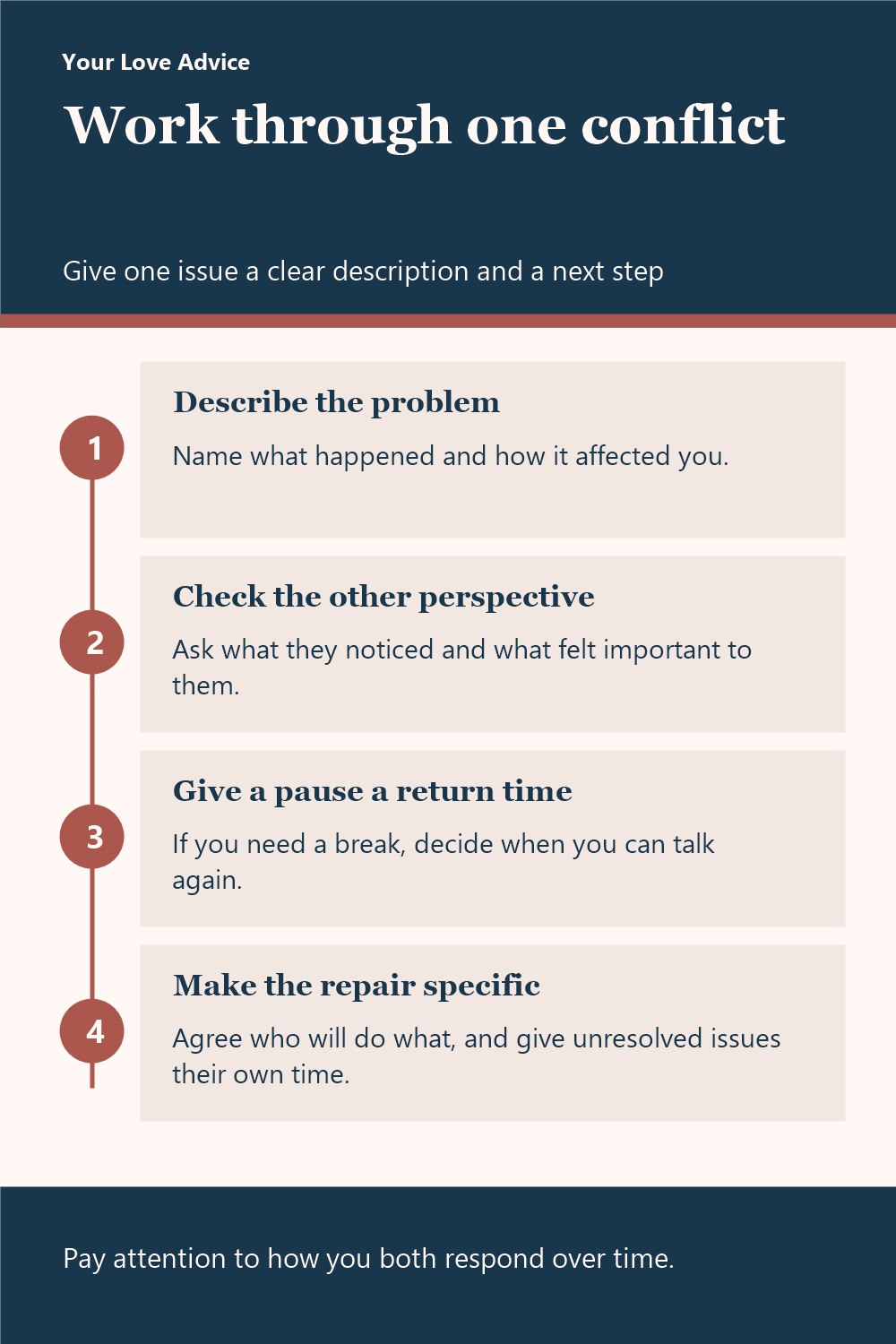
Work through one conflict
- Describe the problem Name what happened and how it affected you.
- Check the other perspective Ask what they noticed and what felt important to them.
- Give a pause a return time If you need a break, decide when you can talk again.
- Make the repair specific Agree who will do what, and give unresolved issues their own time.
Pay attention to how you both respond over time.