

News about an ex can bring up jealousy even when you wanted the relationship to end. You may miss a familiar place in their life, feel left behind or compare their news with a difficult week of your own. The feeling does not make you foolish, and it does not prove that you should get back together.
You cannot always choose the first feeling that appears. You can consider what you do next, including how much information you seek and whether an action respects both your limits and your former partner’s privacy.
On this page
1. Notice what the jealousy is about
Try naming the situation precisely: “Seeing that photograph made me feel replaceable,” or “Their promotion reminded me that I am unhappy at work.” You do not need to turn the feeling into a verdict about your worth.
Ask what you are wanting at that moment. It might be companionship, recognition, reassurance or a change in your own routine. That question can point towards a useful response without making your ex responsible for providing it.
There may also be anger about how you were treated. Acknowledging jealousy does not mean denying harm or accepting blame for the breakup. Several feelings can exist together, and you do not have to decide immediately which one is the “real” feeling.
2. Change the checking routine
Notice how you receive updates: their profile, a mutual friend’s messages or a habit of checking late at night. If looking leaves you unsettled, try a specific limit such as muting updates or asking friends not to send news. You do not have to make a permanent decision today.
If you need contact for shared responsibilities, keep a practical channel available as appropriate. Necessary communication does not require following every social update. Respect their contact limits too; avoid using other accounts or friends to monitor them.
Before sending a message, ask what you want it to achieve and whether a reply is welcome. If the goal is to make them jealous or get proof that they still care, consider writing an unsent note or talking to someone else instead. Your feelings deserve attention without turning into pressure on another person.
3. Give comparisons some context
A photograph or announcement gives you a small part of someone’s life. It cannot establish how happy they are, what their new relationship is like or whether they ever cared about you. You do not need to fill those gaps with a painful story or a comforting prediction.
Feeling attached after an ending can include missing habits, affection and shared plans. If spiritual language is meaningful to you, you can use it for personal reflection without treating an ongoing bond as proof that reunion is destined or contact is owed.
Remember the wider relationship, including the reasons it ended. You can miss good experiences without deciding that the past was entirely better. A new partner, job or social plan is not a score that determines which of you has “won” the breakup.
4. Choose an action for your own day
Pick one action connected to a need you identified. If you want company, invite a friend to something manageable. If work is troubling you, set aside time to consider that issue separately. If you are simply tired of checking, put the device aside for an activity you already enjoy.
You do not have to prove that you are doing better. Posting for your ex’s reaction, rushing into dating or taking on exhausting goals can keep their imagined opinion at the centre of your choices. Ask whether you would still want the activity if they never heard about it.
A walk or other movement that suits you may be an option, alongside rest, an accessible hobby or a familiar task. Prayer or meditation can also have a place if you find it meaningful. None is a requirement or a way to guarantee that an unwanted thought disappears.
5. Seek support without a recovery deadline
You do not need to force forgiveness, suppress every thought or feel positive before making a useful choice. If a thought returns, acknowledge it and bring attention back to what you want to do next. An unsettled moment does not erase your effort.
Talk with someone who can listen without feeding comparisons or collecting news about your ex. If distress is interfering with daily life or feels difficult to manage, consider a qualified professional. Support can focus on your needs without diagnosing your former partner.
There is no universal deadline for feeling differently. For today, one respectful boundary and one manageable plan may be enough to give your own life a little more attention.
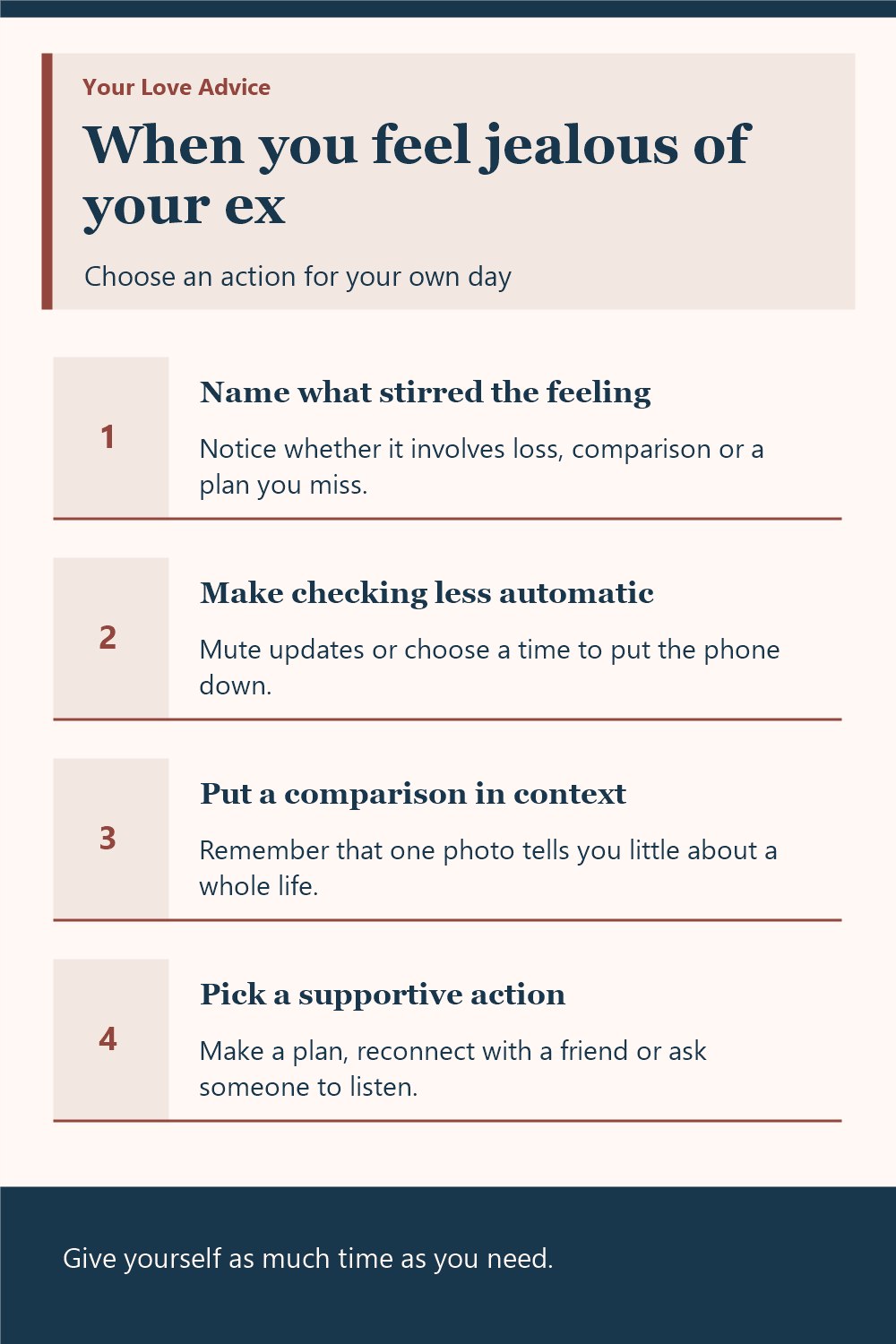
Read the infographic in text
When you feel jealous of your ex Choose an action for your own day
- Name what stirred the feeling Notice whether it involves loss, comparison or a plan you miss.
- Make checking less automatic Mute updates or choose a time to put the phone down.
- Put a comparison in context Remember that one photo tells you little about a whole life.
- Pick a supportive action Make a plan, reconnect with a friend or ask someone to listen.
Give yourself as much time as you need.