

Missing someone after a breakup can make ordinary parts of the day feel unfamiliar. You may miss their company, a shared routine or the future you expected. You can take those feelings seriously while considering what would help you through the next few days.
You do not have to solve the whole breakup at once. Start with the practical situation: has the relationship ended, are you still deciding, or are you temporarily apart? The kind of contact and support you need may be different in each case.
On this page
- 1. Make room for missing them
- 2. Separate distance from a breakup
- 3. Notice difficult moments
- 4. Choose workable contact limits
- 5. Look for manageable moments
- 6. Remember the whole relationship
- 7. Choose one activity for yourself
- 8. Ask for specific support
- 9. Get help when coping is difficult
- 10. Leave room for your own pace
- 11. Make a small daily plan
1. Missing someone does not settle your next decision
You can miss a person and still recognise why the relationship ended. Affection, relief, anger and loneliness may arrive together or at different times. The strength of a feeling does not tell you whether the other person wants contact or whether returning would meet your needs.
A breakup does not by itself establish that you are addicted to someone or that you should treat your feelings as a personal failure. Describe what you are experiencing in ordinary terms: “Evenings are hard because we used to talk then.” That gives you a particular moment to plan for.
2. Separate being apart from a relationship ending
If you are still together but living at a distance, discuss contact, visits and what you each want from the relationship. Ask what is realistic rather than trying to settle uncertainty by checking every message or social media update.
If the relationship has ended, a familiar call may feel comforting while leaving you unclear about what it means. Ask yourself whether the contact serves a practical purpose, a friendship you both want or a hope for a reunion that has not been agreed.
3. Notice which moments need extra care
A birthday, a favourite place or the time you usually ate together may bring memories back. You can plan something modest for a difficult occasion, such as company for a meal or a different evening routine. You do not have to replace a shared tradition immediately.
The University of Sydney’s breakup coping resource describes varied emotional responses, including sadness, anger, confusion and relief. Use that range as room for your own experience, rather than a sequence of stages you must complete.
4. Choose contact limits that fit your circumstances
If checking for updates keeps pulling you into distress, consider muting an account or changing when you look at messages. You can decide how much of your own online space you want to give the breakup. Respect any clear request from the other person to stop contact.
Some former partners still need to discuss children, work, belongings or shared responsibilities. Where contact is safe, a particular channel and a clear practical subject may make those exchanges easier. If there are threats, stalking or fear, seek individual specialist support about safer arrangements.
5. Look for manageable moments
Instead of asking whether you are completely over the relationship, notice what would make today more workable. You might want an uninterrupted hour of work, a meal with company or a quieter bedtime. A difficult afternoon can coexist with a useful change.
Try not to measure your recovery against your ex’s posts or someone else’s timetable. What another person displays does not give you a complete view of their life, and their pace does not set a deadline for yours.
6. Remember the relationship as a whole
You can value a good memory without using it to dismiss repeated hurt or an important difference between you. If reflection helps, name what you enjoyed, what did not work and what you need now. You do not have to make either person entirely wonderful or entirely bad.
If you were mistreated, missing the person does not make you responsible for their behaviour. You can seek support without defending your feelings or producing a perfectly clear account of the relationship.
7. Choose an activity because it matters to you
Return to an interest you miss or try something manageable that you would like to do. It could be reading, a community activity, cooking with a friend or time outdoors. Choose an option that fits your energy, access and budget.
You do not need to make the activity impressive, turn it into self-improvement or use it to meet a new partner. A small part of the week that belongs to you can have value on its own.
8. Ask for the kind of support you need
Give someone a request they can respond to: “Could you keep me company while I cook?” or “Can I talk for ten minutes without trying to decide what to do?” You can also ask for distraction when another discussion of the breakup feels tiring.
Different people may offer different kinds of help. Let a friend explain their capacity and consider wider support if one person cannot carry every conversation. You can keep private details private while still saying that you are having a difficult time.
9. Get help when coping is becoming difficult
If distress is persistent, intense or interfering with sleep, work or basic daily tasks, consider speaking with a qualified health professional or counsellor. You can ask about the help available, costs, accessibility and what the first appointment involves.
You do not need your ex to attend for you to receive support. Where abuse or fear is involved, individual specialist advice may be more suitable than trying to arrange a joint conversation. If you are in immediate danger, seek your local emergency help when you can do so safely.
10. Leave room for your own pace
The Sydney resource also emphasises that coping has no fixed deadline. You may feel differently across days or weeks. Returning feelings do not require you to abandon a boundary or decide that every effort has been wasted.
You can be curious about a new friendship or choose time without dating. Neither choice has to prove that you have healed. Be honest about what you want and what you can offer if you begin a new connection.
11. Make one small plan for the day ahead
Choose a practical need, one manageable activity and a person or service you could contact if the day becomes difficult. Keep the plan flexible enough for your circumstances. For example: prepare something to eat, spend a little time on a familiar task and arrange a short call.
There may still be questions you cannot answer about the relationship. You can leave those questions open while taking care of the part of the day in front of you.
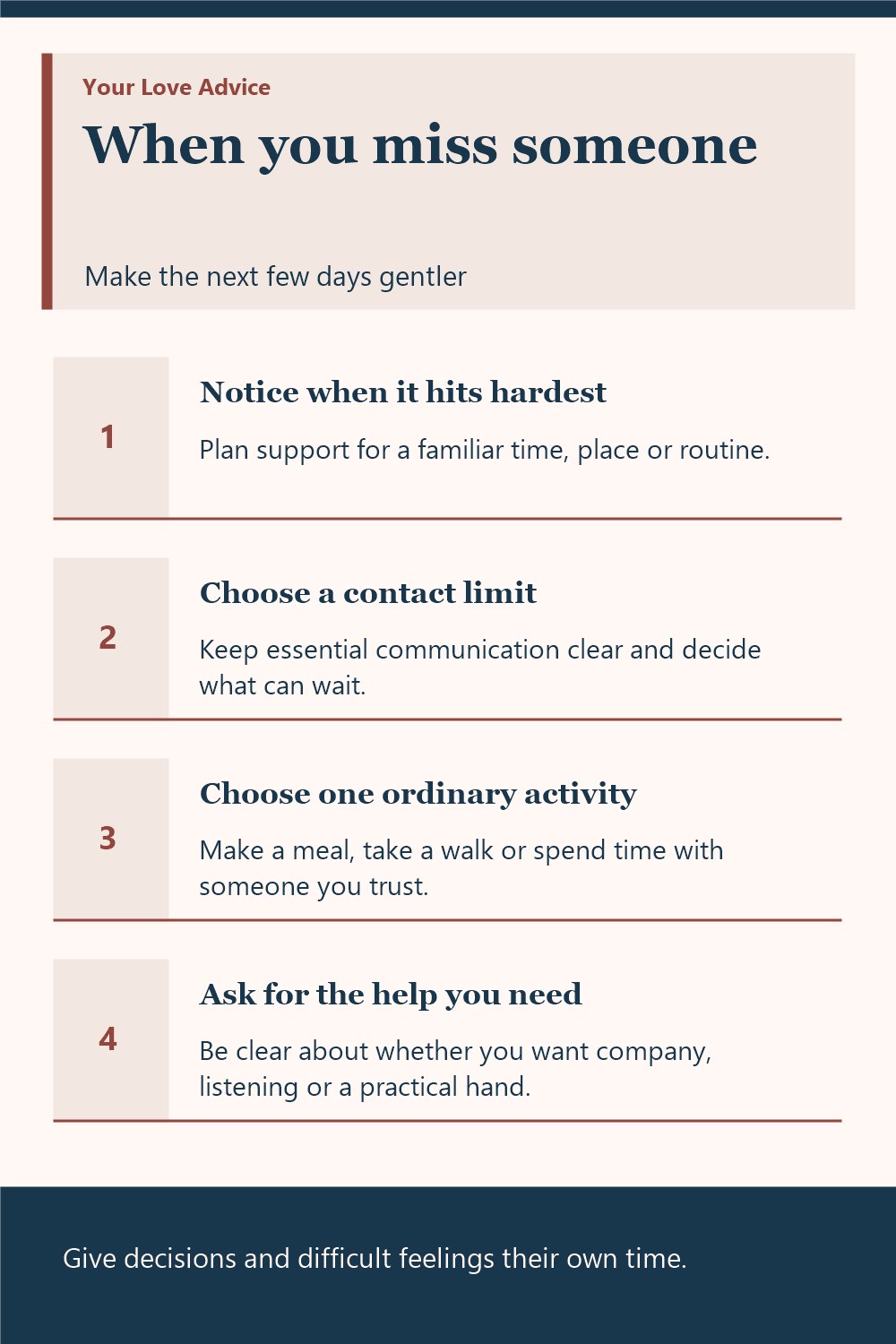
Read the infographic in text
When you miss someone Make the next few days gentler
- Notice when it hits hardest Plan support for a familiar time, place or routine.
- Choose a contact limit Keep essential communication clear and decide what can wait.
- Choose one ordinary activity Make a meal, take a walk or spend time with someone you trust.
- Ask for the help you need Be clear about whether you want company, listening or a practical hand.
Give decisions and difficult feelings their own time.