

After several breakups and reunions, you may wonder whether this ending will last. Feeling calmer, angrier or less interested in contact cannot tell you for certain what happens next. You can miss someone and still decide the relationship is over. You can also feel relief without having every loose end settled.
A more useful question is what you want to participate in now. Begin with the present agreement, the pattern you have experienced and the changes you would need before considering another start.
On this page
Start with what has actually been said
Has one person clearly ended the relationship? Has there been a mutual agreement to take time apart, or has contact simply become uncertain? Those are different situations. If it feels safe and useful, ask for the clarification you need rather than treating silence or a social-media post as a complete answer.
When someone has said no to continuing, respect that answer. A history of reunions does not make a current ending an invitation to persuade them. Equally, you can end a relationship without waiting for the other person to agree that your reasons are sufficient.
You might say, “I am ending the romantic relationship. I can discuss returning our belongings by email, but I am not available to discuss another restart.” Adapt the wording to your circumstances and safety.
Describe the recurring pattern without assigning a label
Write down what tends to happen before a breakup, what draws you back together and what happens afterwards. Be specific: “We disagree about exclusivity, separate for a week, then reconnect without discussing it.” That is more useful than calling yourself weak or describing the other person as incapable of change.
Consider what has genuinely been different after previous reunions. A promise, an intense conversation or missing each other may matter emotionally, but none explains how the original difficulty will be handled next time.
Responsibility does not have to be equal simply because two people are involved. Each person is responsible for their own choices. Threats, deception or pressure should not be dismissed as a shared preference for drama.
Let your feelings be mixed
You do not need to stop loving someone, forgive them or enjoy being alone before deciding not to return. Grief, loneliness, anger and relief can coexist. Having a difficult evening does not invalidate the decision you made during a clearer moment.
Instead of testing whether you are “over it,” ask what would help today. You might want company, rest, a plan for an awkward encounter or someone who can listen without urging you to reunite. Repeatedly checking your former partner’s updates may make the day harder; you can adjust what you see without making a permanent declaration.
There is no requirement to date someone else to prove you have moved on. Choose a pace that fits your wishes and capacity.
Consider a restart only if both people want it
If you are considering another attempt, ask what agreement would be different. What problem needs addressing? What action is each person willing to take? How will you discuss it if the same difficulty returns?
For example, “We will communicate better” is broad. “If either of us needs to change a plan, we will let the other person know as soon as we can and suggest another time” gives you something to discuss and observe.
Both people need room to decline. An apology, a shared history or a promise of change does not create an obligation to reunite. This guide to responsibility, repair and respecting a second-chance decision keeps that choice in view.
Make contact and shared responsibilities workable
Some people want a period without contact. Others need to communicate about children, housing, belongings or other responsibilities. Choose an arrangement that fits the actual situation rather than treating one rule as a test of whether the breakup is real.
You could agree on one communication channel, the subjects you will discuss and a practical time to deal with remaining arrangements. If a friend offers help, agree what you are asking them to do rather than placing them between two competing accounts.
If you fear a reaction, seek private support before announcing a boundary or arranging a meeting. You do not have to have a final face-to-face conversation to earn the right to leave.
Choose one next step you can carry out
Ask, “What do I need this week, and which part can I act on?” A next step might be returning a key, arranging company after work, writing down a contact limit or finding support with a practical concern.
If trust is part of what keeps bringing you back to the same question, consider specific agreements and follow-through. No checklist can promise that a reunion will succeed or that a future relationship will be permanently happy.
You can make a considered choice with some uncertainty still present. The aim is to decide what you are willing to continue, while leaving room to care for yourself as your feelings change.
Read the infographic in text
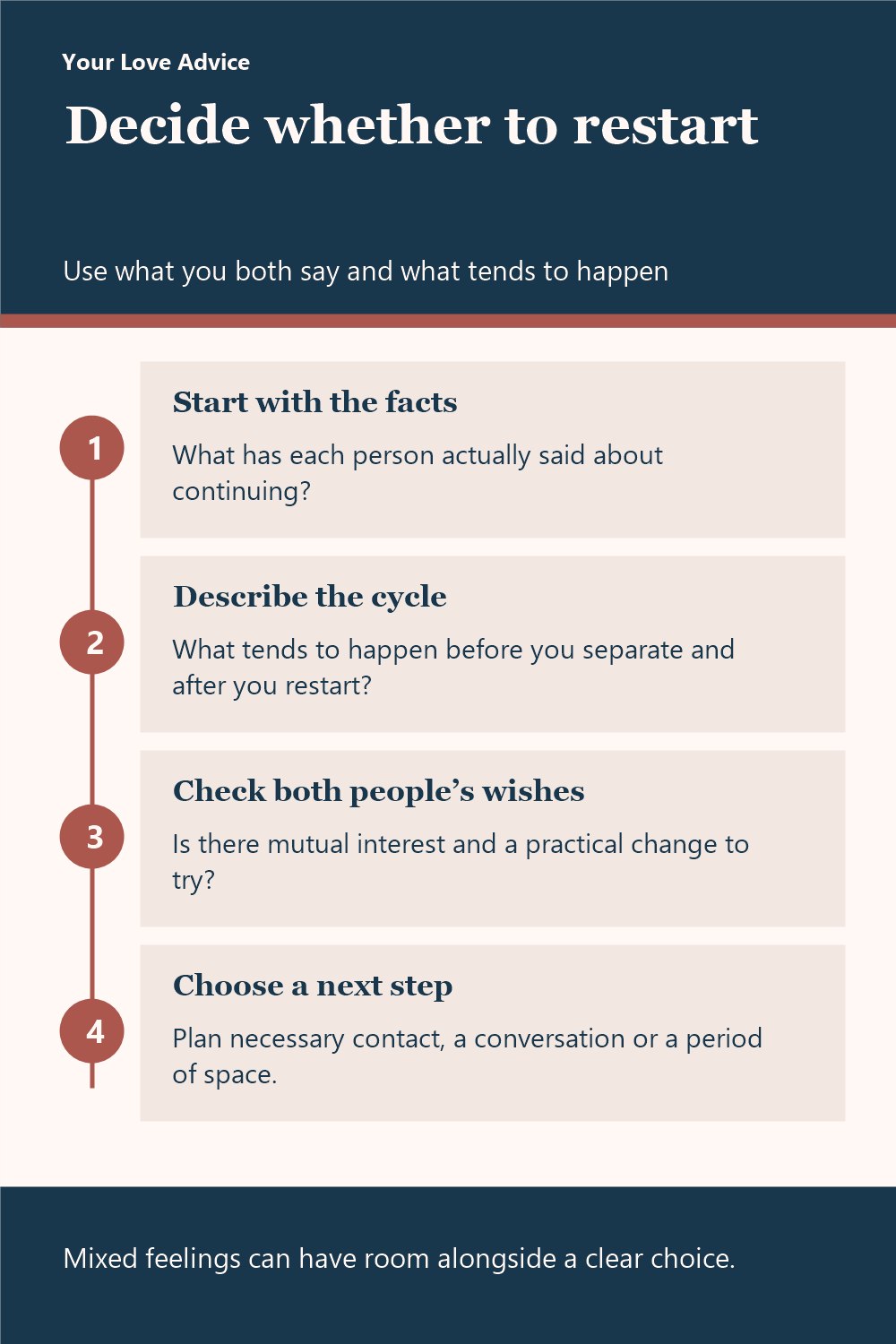
Decide whether to restart
- Start with the facts What has each person actually said about continuing?
- Describe the cycle What tends to happen before you separate and after you restart?
- Check both people’s wishes Is there mutual interest and a practical change to try?
- Choose a next step Plan necessary contact, a conversation or a period of space.
Mixed feelings can have room alongside a clear choice.