

Trustworthy relationship advice online helps you understand a question without claiming to know your whole relationship. A useful source explains what supports its claims, where its expertise ends and what choices remain yours.
Give the closest scrutiny to advice that could change your safety, health, finances, legal rights or children's lives. A confident video, popular label or spiritual interpretation is a starting point for questions, not proof about another person's private thoughts.
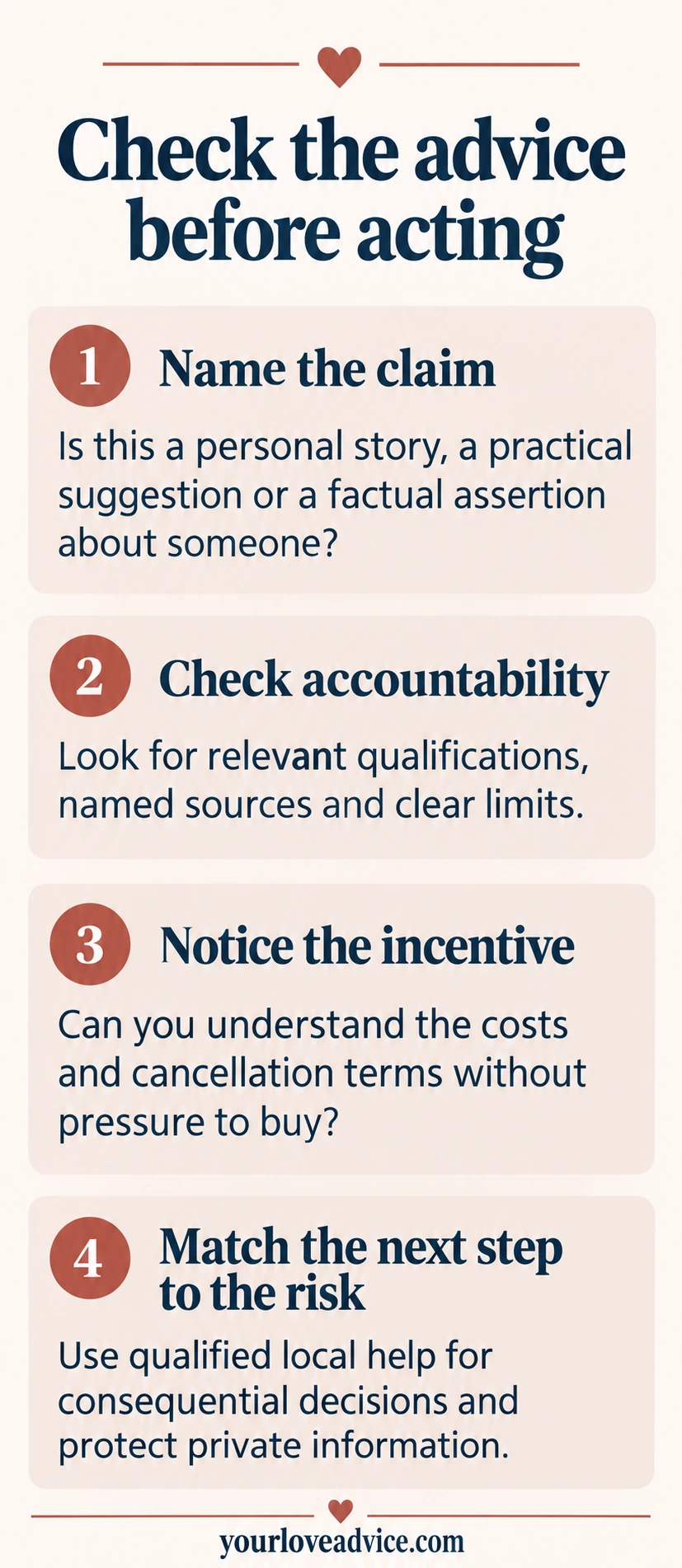
Check the advice before you act
Read the guide as text
- Name the claim. Is this a personal story, a practical suggestion or a factual assertion about someone?
- Check accountability. Look for relevant qualifications, named sources and clear limits.
- Notice the incentive. Can you understand the costs and cancellation terms without pressure to buy?
- Match the next step to the risk. Use qualified local help for consequential decisions and protect private information.
Naming Before Judging
Start by putting the advice in a regular sentence. Say something like: "I try discussing plans before the weekend comes" is a suggestion, but "if your partner avoids a question, they're cheating" is a factual claim about another person.
Different kinds of claims need different kinds of support. In a low-risk conversation, an idea can be looked at carefully, but a claim about a diagnosis, danger, or legal rights needs real evidence and the right kind of context to look at.
Look for content that changes in different categories. A creator might start with a regular anecdote and then come up with a universal conclusion, as though the story proved the answer.
Ask yourself, "What would I do if I really believed this?" This allows the question to make the stakes visible to you. If the answer involves confrontation, spending, surveillance, or big life decisions, look beyond the original post before you take an action step.
Look at the Expertise
Someone can have expertise in one area and limited expertise in another. A therapist who's licensed can talk about communication but not know the local laws. A lawyer can explain a legal process and still does not know about a person's mental health.
Look for their name, qualifications, training, and a way to verify their status through an appropriate regulator when you can. Titles such as "relationship expert" or "relationship coach" don't always mean that they have the right qualifications that you need.
Credentials are just a starting point, and they don't guarantee that everything said is real. Check if the person explains uncertainty, stays in their area of expertise, and shows the difference between education and individualized services.
For clinical questions, the National Institute of Mental Health offers guidance on psychotherapy and choosing a provider. An online content creator's audience size is not a substitute for the qualifications and fit needed for your particular care.
Look Deeper into Evidence
If an article tells you that research proves something, look for a link to the research or a credible explanation of it. Find out if the source looked at the same questions as the creators answering.
A study from a small group of university students might give you insight without telling you how all married parents behave. Associating two things doesn't show that one caused another. One single finding doesn't usually support a confident prediction about your partner.

You don't have to have specialist training to see a mismatch between a headline and an abstract. If the original source can't be found, then look at the claim as unverified instead of just saying it's false.
The National Center for Complementary and Integrative Health explains ways to evaluate online information. Its health-focused guidance about ownership, evidence, and purpose also offers useful questions when relationship content makes health-related claims.
What is the Advice Telling You?
A source of advice might earn money through advertising, affiliate links, courses, subscriptions, or paid consultations. Payment doesn't mean that the advice is wrong, but the incentive should be known and shouldn't decide the conclusion.
Notice whether every disagreement is presented as a reason to buy the creator's product. Be cautious when essential explanations stay behind repeated upgrades or unexplained charges.
A good article should give insight before asking you to buy anything. If a service is offered, the cost, qualification, limits, and cancellation terms should be clear. You can ask whether the advice would make sense if there was nothing for sale. If the answer isn't clear, then look at it with another source.
Don't treat a sales page as a neutral assessment just because it uses a certain kind of therapeutic language or includes people's testimonials.
Pay Attention to Labels
Words such as narcissist, trauma bond, gaslighting, and attachment style can talk about different concepts, and online they should be used to explain the right thing but often are used to explain every hurtful situation.
Instead of starting with labels, look at the behavior. Describing repeated unwanted messages or the denial of an event you clearly remember is more useful than trying to diagnose someone with a personality disorder. Certain behaviors can help you decide on boundaries, with evidence and support.
You do not need a diagnosis to decide that threats, humiliation or unwanted sexual contact are unacceptable. At the same time, a diagnosis doesn't always tell you everything about someone's character or whether they're able to be in good relationships.
Ask if the label helps you understand your options or if they just give you something to be fearful of. Content that encourages you to dislike an entire group might validate you, but it still offers you little guidance about your situation.
Look at the Reviews and Comments
Comments can show whether a reader found an explanation understandable or whether they were pressured by the service, but they can't verify that a claim is scientifically proven or that the provider is perfect for you.
Testimonials can be incentivized, fabricated, or based on short experiences, and a big success story might not show what happened months down the road. A negative review can also ask useful questions without giving full context.
Pay attention to patterns that involve issues such as unclear charges, ignored cancellations, confidentiality, or promises that couldn't be kept. Read the provider's terms and, where applicable, check the relevant professional register.
Do not contact reviewers to demand private details or assume they owe you proof. Use the reviews to ask your own questions and do your own investigation. The goal is to use your judgment and not to decide if the whole relationship history is true just from a few sentences.
Don't Believe Everything AI Tells You About Your Relationship
AI tools like chatbots can be helpful when you're trying to sort through your feelings or figure out how to start a difficult conversation with your partner. They might help you organize your thoughts, suggest ways to communicate, or look at a situation from another perspective. But it's important to remember that AI doesn't actually know your partner, understand their intentions, or have a way to confirm that everything you've shared is accurate. Even when an answer sounds confident, it can still be wrong, leave out important details, or simply tell you what you seem to want to hear.
If you're using AI for relationship advice, try asking it to explain what might be uncertain or whether there could be another explanation for someone's behavior. When it comes to important decisions involving legal matters, health concerns, or personal safety, always check the information with reliable sources or qualified professionals instead of depending on AI alone.
It's also important to think about privacy before sharing personal information. Avoid uploading private conversations, financial records, intimate photographs, or identifying details about children or other people without understanding how the tool handles that information and whether you have permission to share it.
Another thing to watch for is repeatedly asking the same question because you aren't getting the answer you want. For example, if you keep describing an argument differently until the chatbot finally says your partner is completely wrong, you might not be getting useful advice anymore. You could simply be looking for reassurance that your feelings are justified.
But that doesn't mean your concerns aren't important. Sometimes it helps to write down what actually happened, what you're worried about, and what decision you're trying to make. Talking with a qualified professional or someone you trust who can offer an independent perspective might be more helpful than continuing to search for an answer that agrees with you.
Check Important Relationship Advice Before Acting on It
When you come across relationship advice online that could influence a major decision, it's a good idea to check another reliable source before acting on it. This is especially important when the information involves separation, legal rights, financial decisions, or personal safety.
For example, imagine reading a social media post claiming that you should immediately take a particular action during a separation. Instead of assuming the advice applies to everyone, you might check with a local legal aid organization or another qualified professional who understands the situation. If the concern involves abuse or controlling behavior, a specialist support organization might be a more appropriate source.
But remember that finding two websites saying the same thing doesn't automatically mean the information is accurate. Sometimes different blogs repeat the same advice without checking where it originally came from. Try looking for sources that explain their information clearly, provide evidence, or have professional experience and accountability in the subject.
For example, imagine that Natalie reads an online post claiming that anyone who refuses to share their phone password must be hiding an affair. She's already been feeling uncomfortable about something happening in her relationship, so the post makes her even more suspicious.
Instead of immediately demanding access to her partner's phone, Natalie decides to look into advice about privacy and healthy boundaries. She also takes some time to think about what's actually been bothering her. As she considers the situation, she realizes that her biggest concern isn't the phone at all. It's that her partner has been making purchases from their shared account without discussing them.
Rather than turning the situation into an argument about passwords, Natalie decides to have a conversation about their finances and expectations around spending.
The important thing is remembering that checking advice doesn't mean ignoring your concerns or pretending that something isn't bothering you. It simply gives you an opportunity to understand the situation better before making a decision.
Sometimes taking a little time to verify what you've read can help you focus on the real problem instead of reacting to advice that sounds convincing but might not fit your circumstances.
When Uncertainty is High, Start with Action Steps
When uncertainty is high, start with an action step that gets information without creating a risk. Write down examples, ask a question when safe, and book an individual consultation.
Don't turn a regular article into permission to monitor, accuse, or access another person's account. These kinds of actions can take away privacy, cause more conflict, and have legal consequences. If someone suggests a step that you can't reverse, ask what professional or practical support is needed first. Advice can look good without giving you the exact plan.
You can act on clear danger without getting proof. If you're being threatened or your safety is challenged, get the right kind of help. Being careful and having a careful evaluation are supposed to help you in your judgment, not delay your protection until a source agrees with you.
Getting Advice
Before you turn it into a story, a forum group, or a coaching service, find out who can see it and whether it can be republished. Taking away a name might not take away the identifying details, such as the school, workplace, or a family event.
Share as little as you need to in order to explain the question. Use general ages, get rid of account information, and don't post private messages or intimate details about children. Know that if you delete a post, it might not remove screenshots or versions that are copied.
If using paid services, ask how the records are stored, who can get access to them, and what confidentiality applies. Confidentiality arrangements are different in different situations, such as coaching, public forums, and messaging apps.
If a source demands personal information before explaining its service, don't give it to them. You're allowed to decline, pick another provider, or ask questions without giving detailed records of your family's life.
Choosing the Right Kind of Advice
Online advice that's useful can give you vocabulary, questions, and resources, and can tell you what next steps to take. It can't show your whole relationship or guarantee an outcome.
Ask yourself what you understand more clearly, what you're uncertain about, and what one action you can choose. If you're confused, frightened, ashamed, or dependent on more content, reconsider the value. You don't have to reject every source because it's imperfect, and you can keep helpful communication while questioning diagnoses that are unsupported.
Trust comes from transparency, real expertise, and sound evidence. Trust also happens when someone respects your freedom. Get advice that helps you to think clearly and make your own choices. The best next step should be yours, not something that creates urgency.
Choose checks for relationship advice online
Select the kind of advice you are reading for questions to ask before acting on it.
This tool organises questions. It cannot verify a person or decide whether an online claim is true.
Use the questions and examples in the article above; the draft builder needs JavaScript.
15 questions readers ask
1. What makes relationship advice trustworthy?
Look for relevant expertise, identifiable sources, clear limits, transparent costs and respect for your choices. Confidence alone is not evidence.
2. Are large follower counts a sign of expertise?
No. Popularity can show reach without showing training, accuracy or whether the advice applies to your situation.
3. How can I check a professional's credentials?
Look for their full name and qualification, then verify current status through the relevant regulator or professional register when applicable.
4. Is a relationship coach the same as a licensed therapist?
No. Titles, training and regulation vary. Ask what service is offered, what qualifications apply and how complaints or confidentiality are handled.
5. Does a research link prove the headline?
No. Check whether the source actually studied the question and whether the headline goes further than its findings.
6. Can reviews tell me whether advice will work?
Reviews can raise useful questions about service and charges. They cannot establish that a claim is scientifically proven or predict your outcome.
7. What sales pressure should concern me?
Watch for guarantees, urgent upgrades, hidden costs or claims that only the seller can prevent a feared outcome. Take time to compare terms and independent information.
8. Can online advice diagnose my partner?
A post or chatbot cannot establish a diagnosis from your account. Describe behavior and its impact rather than relying on a label.
9. Can spiritual guidance still be useful?
It may support reflection when it fits your beliefs. It should leave you free to question, decline spending and seek qualified help for practical concerns.
10. Should I share private messages for advice?
Consider privacy, consent and who can access or republish them. Share the minimum necessary and avoid exposing children's or other people's identifying details.
11. Can AI tell whether someone is cheating?
No. A chatbot cannot verify events or read another person's thoughts. Use it cautiously for organizing questions, then check important claims independently.
12. Are two agreeing websites enough verification?
Not necessarily. They may repeat the same unsupported source. Seek evidence and relevant professional accountability.
13. When should I get local professional help?
Use appropriate qualified help for legal rights, health, finances, separation arrangements or personal safety. General online advice may miss crucial facts.
14. Do I need proof before seeking safety support?
No. You can contact a specialist support service about threats or controlling behavior without first proving a diagnosis or winning an argument.
15. What should I do with advice that frightens me?
Pause, name the claim and check its support. Seek an independent perspective, especially before confrontation, payment, surveillance or a major decision.