

When someone does not share your romantic feelings, the disappointment can be painful even if a relationship never began. You may grieve a possibility, feel embarrassed about hoping or wonder whether remaining close will make the feelings harder to manage.
You do not have to stop caring immediately. The next step is to respect the relationship the other person is actually offering and consider what contact and support are workable for you.
On this page
- Clarify an uncertain situation without pursuing a different answer
- Care about someone without putting your life on hold
- Leave forgiveness and self-blame out of the requirements
- Keep everyday care and support within reach
- Make shared spaces and contact more workable
- Choose one next step and allow feelings to change gradually
Clarify an uncertain situation without pursuing a different answer
If romantic interest has never been discussed and an invitation would be appropriate, you can ask once in a way that leaves room for a free answer. “Would you like to go on a date?” is clearer than trying to interpret every friendly gesture.
If they decline, say they want friendship or do not respond to an invitation, do not keep asking for proof that they might change their mind. Kindness, a compliment or a shared memory does not cancel a no.
You also do not have to disclose every feeling if doing so would be unsafe, inappropriate or unwelcome. Consider the actual situation, including existing commitments or a workplace power difference, rather than treating a declaration as a requirement for moving forward.
Care about someone without putting your life on hold
You can wish someone well and still decide that regular private contact is too difficult for now. Caring from a distance is one possible choice; it should not become a promise to wait indefinitely or provide the benefits of a partnership that has not been agreed.
Ask what you can freely offer without expecting romance in return. If a friendship feels possible only while you imagine it becoming something else, you may need a different amount of contact.
Time apart does not have to be an attempt to make the person miss you. It can simply be an arrangement that helps you live with the answer you have received.
Leave forgiveness and self-blame out of the requirements
Someone does not owe romantic feelings because you care about them. Their lack of interest is not automatically a wrongdoing to forgive. Equally, you do not need to excuse actual deception, cruelty or a broken agreement to acknowledge that a relationship is not mutual.
Feeling hopeful does not make you responsible for being misled. If you are blaming yourself for every sign you interpreted, consider what you knew at the time and what you want to do differently now.
The guide to forgiveness, accountability and personal boundaries offers optional reflection. Forgiveness is not a condition you must meet before reducing contact or asking for support.
Keep everyday care and support within reach
Choose activities and people that help you feel connected to your own life. That might mean a familiar meal with a friend, a manageable task, time outdoors or an interest you have missed. You do not need a dramatic reinvention.
You can talk about what happened with someone who listens respectfully. A rule that you must never mention the person can make support harder to reach. At the same time, if repeatedly analysing messages leaves you feeling worse, you can ask for company without another discussion of the relationship.
There is no requirement to accept the next date you are offered. If you want to date again, this guide to your needs and pace after heartbreak leaves room for different choices.
Make shared spaces and contact more workable
If you share friends, work or activities, consider what practical boundaries would help. You might prefer group settings, fewer private messages or a break from one-to-one plans. Explain only what is useful and safe to explain.
You can mute updates or change what you follow without making a public statement about the person. Avoid using friends to monitor their dating life or pass along messages after they have asked for space.
Respect also runs both ways. You do not have to discuss their romantic life, provide constant reassurance or remain available in ways you no longer want. A boundary describes your participation rather than trying to control whom they date.
Choose one next step and allow feelings to change gradually
Ask what would make this week a little more manageable. You could adjust one form of contact, arrange a supportive conversation or make a plan for a shared event.
Sadness returning does not mean that you failed or should make another attempt to persuade them. Your feelings may take time to settle, and there is no reliable deadline.
If distress is affecting sleep, work or everyday care, consider suitable professional support. You do not have to reach a crisis or decide exactly what to call your feelings before asking for help.
A mutual relationship needs both people’s choice. You can respect that truth while treating your own disappointment with care.
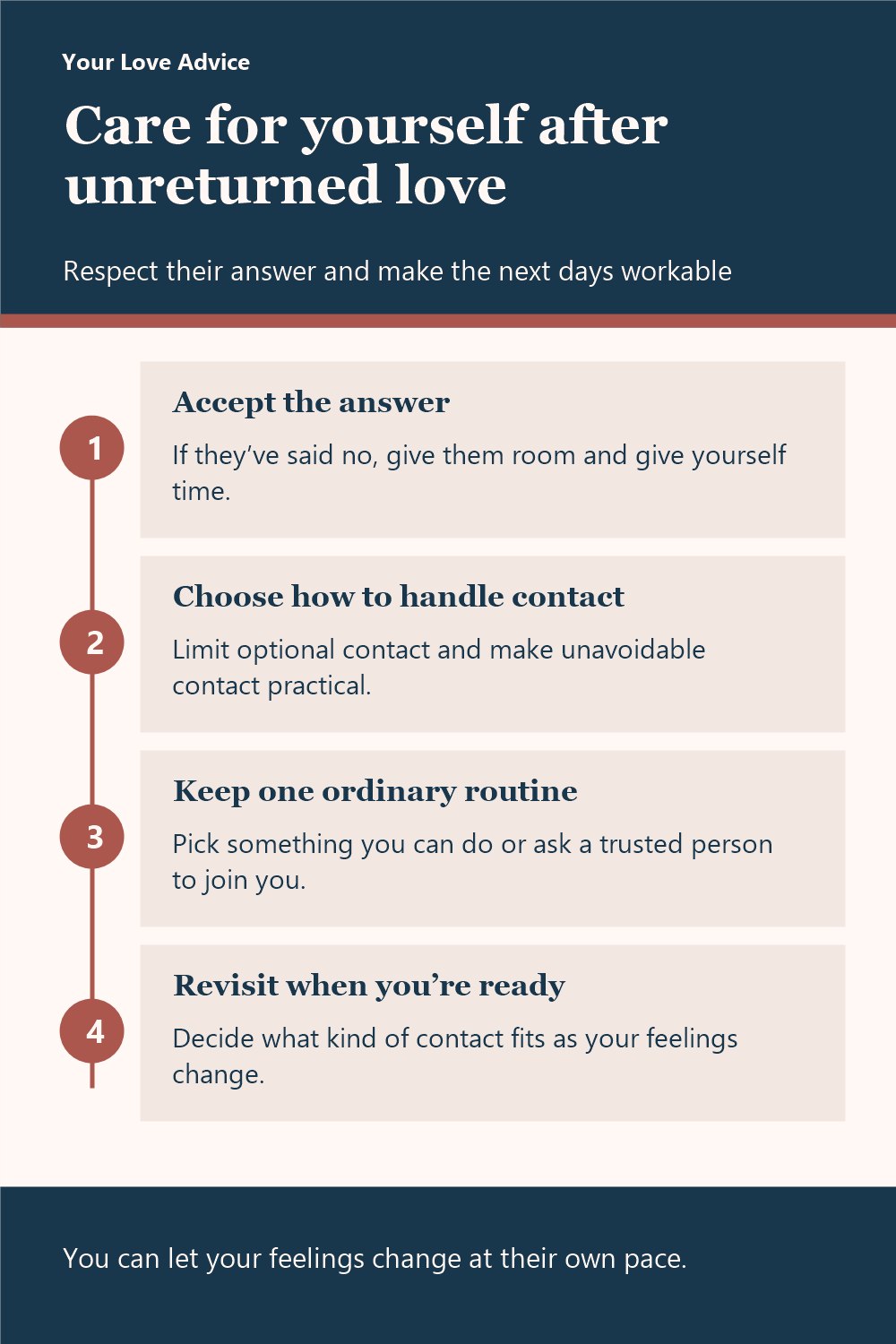
Read the infographic in text
Care for yourself after unreturned love
- Accept the answer If they’ve said no, give them room and give yourself time.
- Choose how to handle contact Limit optional contact and make unavoidable contact practical.
- Keep one ordinary routine Pick something you can do or ask a trusted person to join you.
- Revisit when you’re ready Decide what kind of contact fits as your feelings change.
You can let your feelings change at their own pace.