

Does “love you” mean less than “I love you”? The missing word alone cannot answer that. Both phrases can express sincere affection, and either can be said without the commitment you want. The useful question is what the person means and how that fits the relationship you share.
If a change in wording has unsettled you, you do not have to dismiss your feelings or treat a short message as a hidden confession. Start with context, then ask for the clarity you need.
On this page
1. Avoid decoding one missing word
People may shorten a phrase in a quick text, speak differently with different loved ones or prefer a particular expression. You cannot determine which explanation applies from grammar alone. Omitting “I” does not establish a person’s emotional intelligence, attachment style or ability to love.
The complete phrase is not a guarantee either. A fluent declaration does not settle whether someone wants exclusivity, a shared home or marriage. Those are choices to discuss separately, even when the feelings seem clear.
2. Notice context without inventing motives
Ask what prompted your concern. Was this their usual goodbye, a brief reply during a busy day or a change after an important conversation? A pattern may give you a reason to ask a question. It still cannot reveal a secret motive.
Separate the observation from your interpretation. “Their last few messages were shorter” describes something you noticed. “They are preparing to leave” is a possible explanation you have not confirmed. Keeping that distinction can make your next conversation more focused.
If you often find yourself rereading messages for reassurance, pause before collecting more clues. You might write down the actual question you want answered: whether you are exclusive, whether something has changed or whether you need more affectionate communication.
3. Ask about what matters to you
Choose a time and way of talking that feels comfortable and safe. A gentle opening could be: “I noticed I’ve been worrying about what ‘love you’ means. What does that phrase mean to you?” Give them room to answer without supplying the answer you hope to hear.
Then name your own preference: “Hearing ‘I love you’ sometimes feels reassuring to me.” A preference is something you can share and discuss. It does not make another person responsible for repeating a script whenever you request it.
If the underlying concern is commitment, ask that directly: “Are we agreeing to be exclusive?” Avoid making one exact phrase serve as an answer to every relationship question. Love is respect’s boundary guidance offers a useful starting point for discussing needs and limits.
4. Consider words alongside everyday care
Notice whether each of you listens, respects refusals and follows through on agreements. These observations give you information about the relationship you are living. They do not require you to guess what another person feels internally.
Examples matter more than a perfect score. Perhaps someone keeps plans and shows kindness but rarely uses affectionate language. You can discuss whether there is a way to meet both people’s needs. If loving words regularly accompany humiliation or controlling demands, the affectionate phrase does not make those actions acceptable.
Privacy also belongs in a caring relationship. You do not need access to someone’s phone to settle the meaning of a message, and you do not owe access to yours.
5. Choose a response that respects you both
After talking, consider what you learned. You may feel reassured, understand a different communication habit or recognize that your expectations do not match. You can ask for a specific change and see whether it is freely offered and sustained.
If the conversation brings threats, pressure or fear, seek support rather than trying to find wording that will make the person respond kindly. The Hotline’s relationship spectrum describes concerning behaviors and healthier alternatives.
You can want warmth and clarity without policing every sentence. A relationship gives you more information through ongoing conversations and choices than through the presence or absence of one word.
Read the infographic in text
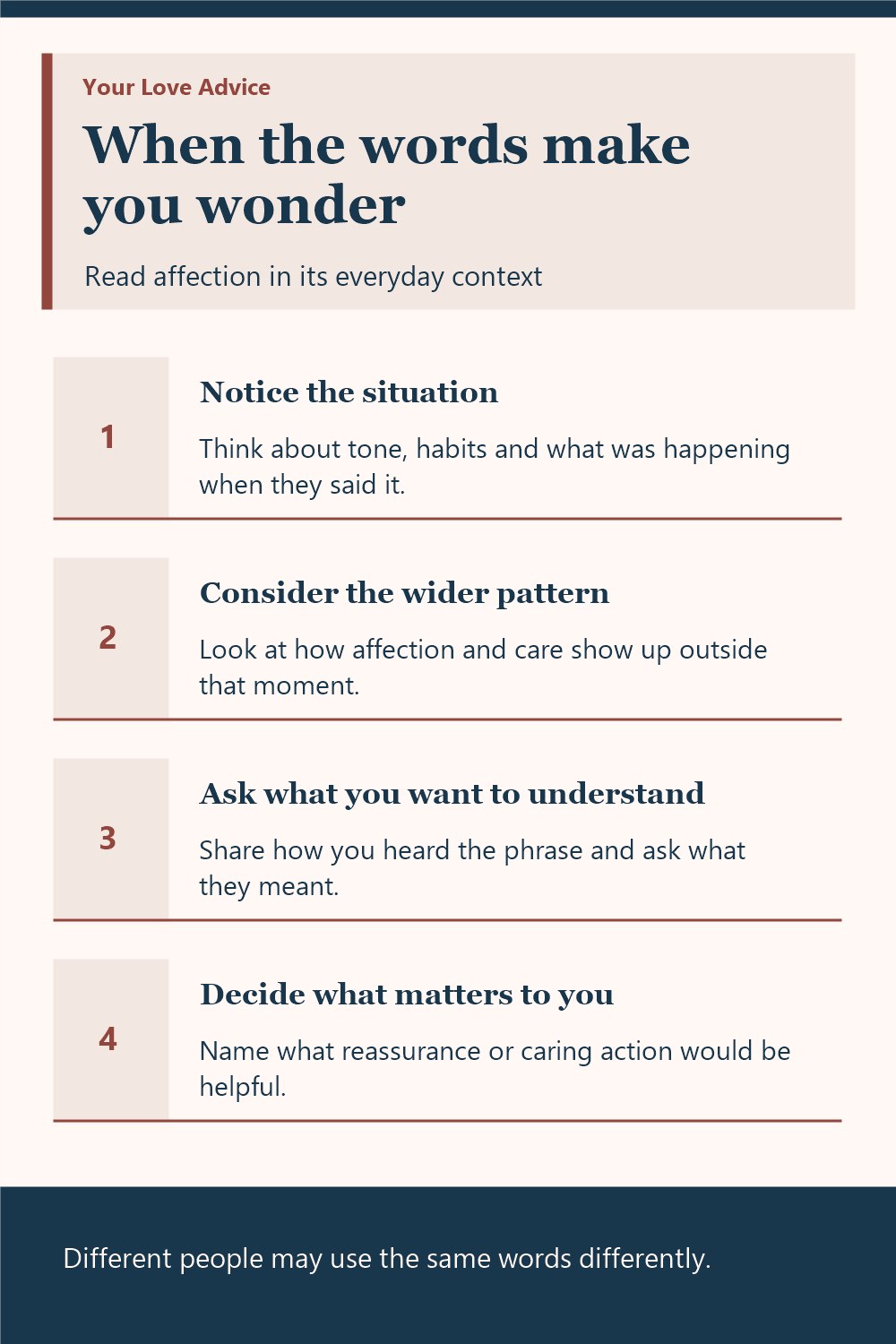
When the words make you wonder
Read affection in its everyday context
- Notice the situation Think about tone, habits and what was happening when they said it.
- Consider the wider pattern Look at how affection and care show up outside that moment.
- Ask what you want to understand Share how you heard the phrase and ask what they meant.
- Decide what matters to you Name what reassurance or caring action would be helpful.
Different people may use the same words differently.