

When you like someone, it is understandable to hope they will feel the same way soon. There is no reliable technique for making another person fall in love faster. You can show interest, make spending time together easier and learn whether the interest is mutual.
You also get to decide whether you enjoy the connection. Dating does not have to become a performance in which every outfit, message and silence is arranged to win someone over. A useful next step gives both people room to respond honestly.
On this page
Offer a clear invitation
Start with an invitation that is easy to understand: “I’ve enjoyed talking with you. Would you like to have coffee with me on Saturday?” It communicates more than hoping the right social-media post will reveal your feelings for you.
Make the invitation specific enough to answer, with room to decline. A short visit to a café or a walk in a familiar public place can be easier to arrange than an elaborate surprise.
If they suggest a different time, see whether you can make a plan together. You do not need to interpret the delay as either rejection or proof of hidden attraction.
A “no,” a request for no contact, or a block is a limit to respect. Do not approach through another account, recruit friends to persuade them, or turn up where they are to seek a different answer.
Get to know each other
Ask about something you would actually like to understand: a hobby, a recent event or what they enjoy about their week. Listen to the answer instead of rehearsing your next impressive story.
Share your own interests too. If you dislike an activity they love, you can be curious without pretending to love it yourself. Discovering a difference is useful information.
You can choose clothes that feel comfortable and appropriate for the plan. There is no required colour, makeup routine or body type that earns someone’s affection.
Leave space for ordinary conversation. You do not need to fill every pause, stage mystery or copy their movements. A date can be pleasant without feeling polished.
Mutual friends can provide a setting to meet, but they do not owe you private information about someone. Keep conversations and messages private unless you have permission to share them.
Choose an activity both people want to try. Shared enjoyment might be a bookshop visit or a simple meal; an expensive outing or extreme adventure is not a shortcut to closeness.
Notice mutual interest
Look at the overall exchange. Do you both ask questions, contribute ideas and make time when you can? One smile, quick reply or copied gesture cannot tell you whether someone wants a relationship.
Be interested in your own experience. Can you speak freely? Are your preferences heard? Do you enjoy who they are, or mainly the possibility of being chosen?
If the direction is unclear, ask. “I’d like to keep seeing you as a date. Is that what you’re interested in too?” is more useful than creating jealousy to measure their reaction.
Different schedules and communication habits can create uncertainty. Discuss what works rather than calculating the perfect delay before answering a message. Being consistently unavailable to appear desirable can make practical planning harder.
Keep your friendships, interests and commitments. Your life does not need to shrink around a person you are still getting to know, and independence does not have to be an act designed to attract them.
Respect comfort and pace
Check before touching or becoming more intimate. You might ask whether they would like to hold hands or kiss. A clear question leaves less room for misunderstanding than trying to read body language alone.
Flirting, accepting a drink or agreeing to a date does not establish consent to further intimacy. Love is respect explains what consent looks like, including the right to stop after previously agreeing.
There is no required first-date timetable for sex. Each person needs to be able to choose freely, without pressure, impaired judgment or fear of losing the relationship for saying no.
You can discuss important goals without asking for an instant commitment. “I’m looking for a relationship, rather than something casual” gives useful information. Neither person has to promise a shared future before they know one another.
Private information can be shared gradually. Taking time is different from deliberately presenting a false identity or hiding a fact that directly affects an agreement you are making together.
Respond to the answer
If the interest is mutual, choose another plan and keep learning about each other. You do not have to decide immediately whether this is lasting love.
If someone is unsure, you can give them space without offering to wait indefinitely. Decide what amount of uncertainty is workable for you and say so kindly.
If they want friendship and you want romance, consider whether friendship is comfortable for you now. Taking distance is an option; staying close as a hidden campaign to change their mind is unlikely to give either person clarity.
Rejection can be disappointing without being a verdict on your appearance or character. Avoid turning the answer into a list of personal defects you must repair to become lovable.
Make one manageable plan for yourself if you feel preoccupied: see a friend, return to a routine or put the conversation away for the evening. You do not need to feel unaffected before you move forward.
The aim is to discover a connection both people choose. Showing interest clearly, listening to the answer and respecting your own needs gives you a more useful direction than trying to make love arrive on a deadline.
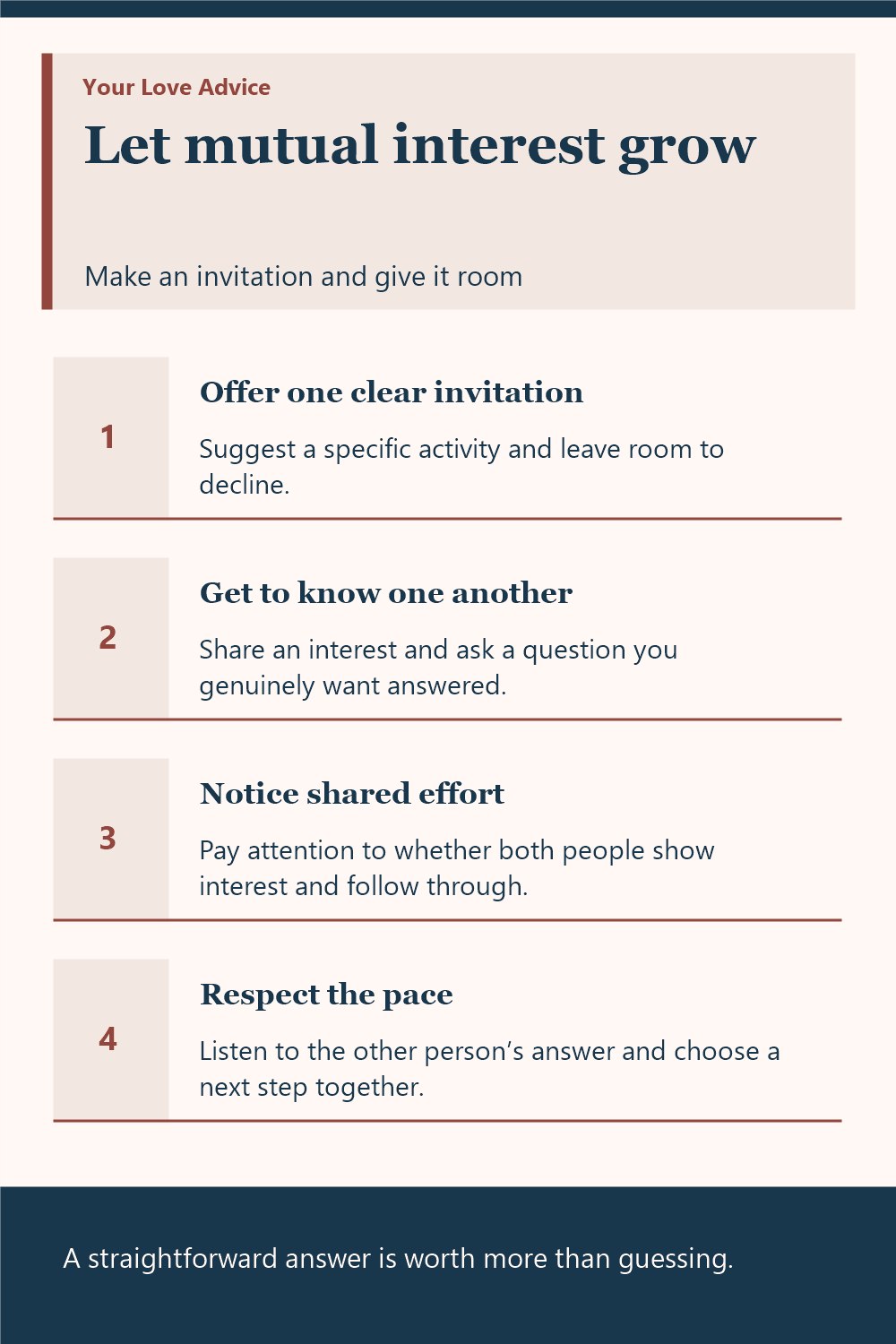
Read the infographic in text
Let mutual interest grow
Make an invitation and give it room
- Offer one clear invitation Suggest a specific activity and leave room to decline.
- Get to know one another Share an interest and ask a question you genuinely want answered.
- Notice shared effort Pay attention to whether both people show interest and follow through.
- Respect the pace Listen to the other person’s answer and choose a next step together.
A straightforward answer is worth more than guessing.