

When affection changes in an established relationship, it can leave you uncertain about where you stand. Perhaps there are fewer hugs, less time together or fewer expressions of love. Those changes deserve a conversation, but they do not tell you exactly what your partner feels or why.
You do not have to prove that someone is secretly in love with you, and you do not have to dismiss your own need for closeness. These six steps can help you describe what has changed, ask useful questions and decide what you want to do next.
On this page
1. Describe the change without deciding its meaning
Start with something you can describe: “We used to spend Saturday mornings together, and we have not done that recently.” This gives both people a shared subject. “You are hiding your love” or “You do not care anymore” assumes an explanation before your partner has answered.
Separate an observation from the story you are telling yourself. Fewer affectionate messages might leave you feeling lonely or worried about the relationship. Those feelings matter, even while the reason for the change remains unclear.
Stress, tiredness, conflict, changing preferences or changing feelings are possibilities, rather than conclusions you can draw from a single behaviour. A person’s gender does not establish their private motives. Notice the pattern and context, and leave room for an answer that differs from what you expected.
2. Ask an open question at a workable time
If it feels safe to talk, choose a moment when neither person is rushing or already in the middle of an argument. You might ask, “I have noticed less affection between us lately, and I miss feeling close. How have things been for you?”
Listen for what your partner actually says. You can ask a follow-up question or check your understanding without supplying a motive for them. “Do you mean you want more time alone after work?” is more useful than insisting that fear of rejection must explain their behaviour.
If now is a difficult time, suggest another opportunity: “Could we talk after dinner tomorrow?” A pause can be reasonable. Repeatedly declining every opportunity leaves a practical question about whether the two of you can discuss the relationship.
The Mental Health Foundation’s guidance on building and maintaining healthy relationships includes understanding your needs, communicating and setting boundaries. You can prepare a few points in advance and take a break if the conversation becomes too much.
3. Explain what closeness means to you
Try naming the kind of connection you miss. Is it a warm greeting, an unhurried conversation, affectionate touch, shared activities or hearing that you matter? “Be more loving” can leave each person imagining a different request.
Make a request your partner can understand and freely answer. For example: “Would you like to take a short walk together after dinner twice this week?” or “I would appreciate a check-in when our plans change.” Discuss whether the arrangement fits both people’s time and preferences.
You may also need reassurance about the relationship itself. It is reasonable to ask, “Do you want to continue this relationship?” An affectionate gesture cannot answer every question about commitment, and a difficult conversation does not automatically mean the relationship is ending.
Our guide to everyday relationship care and shared choices offers practical ways to discuss time, closeness and responsibilities. Choose something relevant to the difficulty you actually have.
4. Respect privacy, preferences and consent
People can express affection differently in public and in private. Your partner may welcome a quiet evening together and dislike public displays of affection. Ask about the distinction rather than treating a social-media post, a kiss in public or access to a phone as required proof of love.
Physical closeness needs to be welcome each time. A relationship, previous intimacy or a request for reassurance does not create an obligation to hug, kiss or have sex. If either person is unsure or declines, stop and respect the answer.
You can respect a limit and still explain your own needs. The question becomes whether there is a form of connection that both people want. Neither person has to accept an arrangement that leaves them persistently unhappy, and neither has to provide unwanted affection to prevent the other from leaving.
5. Consider the response and any agreed changes
After a conversation, consider what each person has said and chosen to do. If you agree to spend time together or revisit an unresolved issue, make the plan specific enough to recognise. Allow for ordinary disruptions and talk about changes rather than keeping a secret score.
A missed plan can need an explanation or a new arrangement. A repeated pattern of dismissed concerns may lead you to reconsider what is available in the relationship. Look at the pattern in context without turning one delayed reply into a complete verdict.
If the uncertainty centres on particular words, our guide to what “love you” and “I love you” can tell you explains why wording alone cannot settle the question. Ask what your partner means, and consider whether their choices fit what you have discussed.
6. Choose your next step without needing every answer
You might choose another conversation, a small agreed change, individual support or a discussion about relationship counselling if both people want it. You can also decide that the available relationship does not meet your needs. Understanding every private motive is not a condition for making your own choice.
If raising a concern leads to threats, intimidation or fear, prioritise your safety and seek confidential support from a trusted person or an appropriate local service. You do not need to arrange a private confrontation or a joint conversation to prove you have tried hard enough.
Affection can change for many reasons, and no checklist guarantees that it will return. Start with what you have noticed, say what matters to you and consider the response. A useful next step leaves room for honesty, consent and both people’s choices.
Read the infographic in text
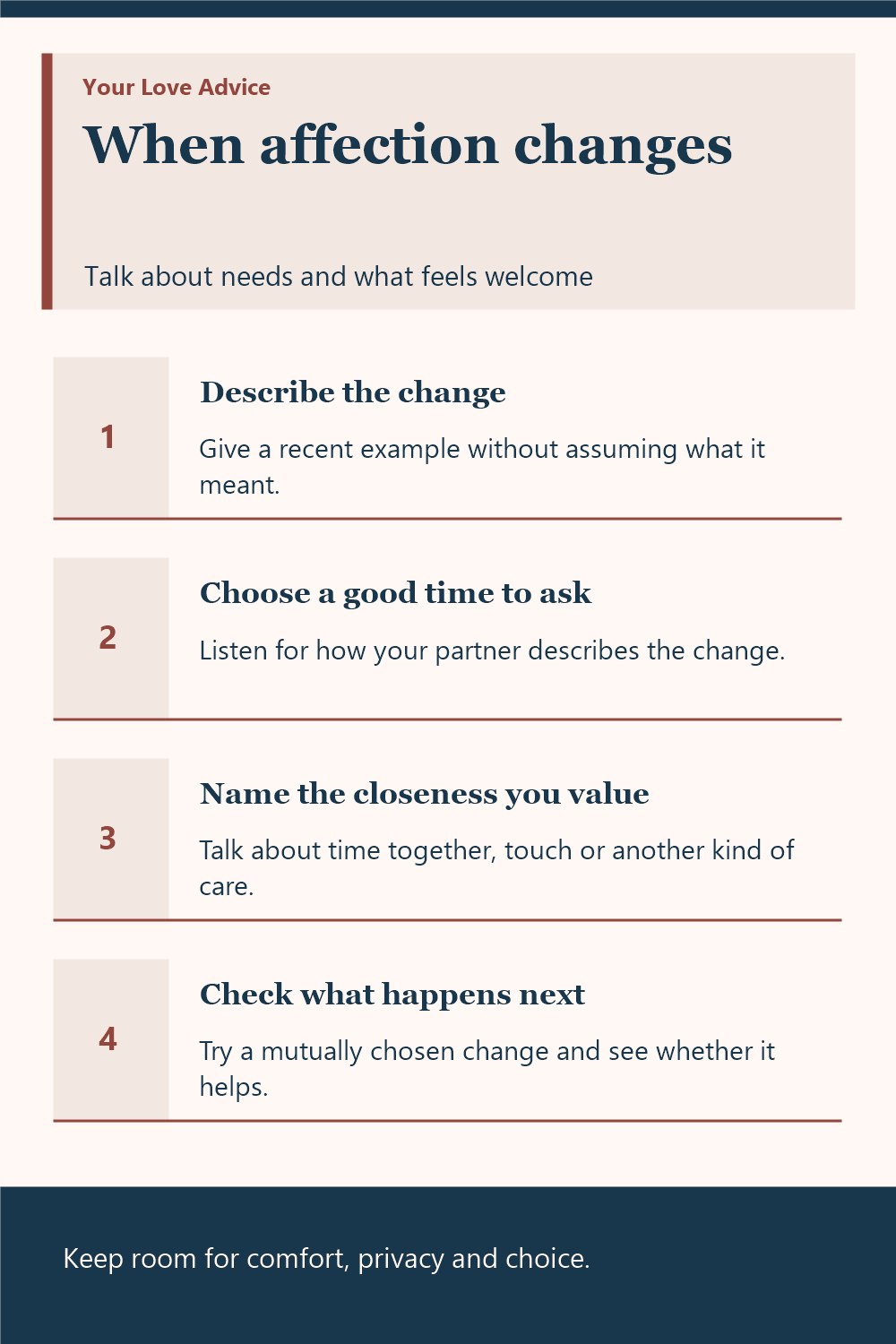
When affection changes Talk about needs and what feels welcome
- Describe the change Give a recent example without assuming what it meant.
- Choose a good time to ask Listen for how your partner describes the change.
- Name the closeness you value Talk about time together, touch or another kind of care.
- Check what happens next Try a mutually chosen change and see whether it helps.
Keep room for comfort, privacy and choice.